Born
June 2, 1940
Athens, Greece
Died
January 10, 2023
Athens, Greece
Known for
King of Greece from 1964 to 1973
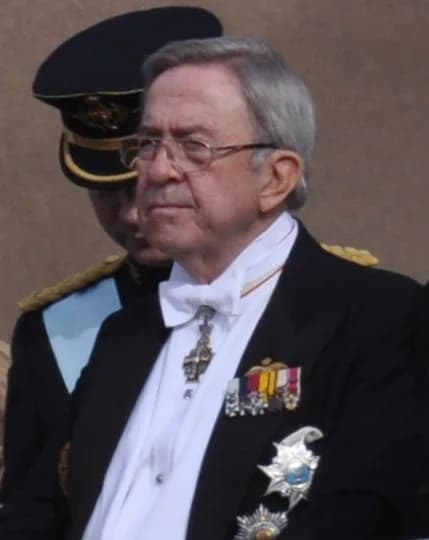
Constantine II of Greece (1940–2023) was Greece best known for King of Greece from 1964 to 1973.
Constantine II of Greece (June 2, 1940 – January 10, 2023) was a monarch and sailor from Athens, Greece. He served as the last King of Greece, reigning from 1964 until the monarchy's abolition in 1973. His legacy marks a significant transition in Greece's modern history.
Chapter
Life chapters
Chapter 1 · 1940· Chapter 1 of 8
Introduction: A Life of Royal Service and Historical Change
Constantine II of Greece (June 2, 1940 – January 10, 2023) was a figure whose life was intrinsically linked to a defining era in modern Greek history. As a monarch and a sailor, his journey saw him ascend to the throne as King of Greece and preside over a significant period of national transformation. Born and dying in Athens, Greece, his existence was bookended by the very city that symbolized his country's ancient heritage and evolving future.
His reign, from 1964 until the monarchy's abolition in 1973, cemented his place as the last King of Greece. This designation carries with it a unique historical weight, marking the conclusion of a centuries-old institution in a nation rich with royal traditions. His life thus represents both a continuation of his lineage and a crucial transition point in Greece’s political landscape.
Chapter 2 · 1940· Chapter 2 of 8
Early Life and Royal Origins
Constantine II entered the world on June 2, 1940, in the venerable city of Athens, Greece. His birth occurred amidst a period of considerable global upheaval, as Europe was already experiencing the early stages of the Second World War. As a member of the Greek royal family, his early life was shaped by an awareness of the lineage and expectations that came with his position.
Born into a family that had deep roots within the constitutional monarchy of Greece, his upbringing would have prepared him, both formally and informally, for the responsibilities he would one day assume. The cultural and historical richness of Athens, a city known as the cradle of Western civilization, formed the backdrop for his formative years. This environment provided a profound connection to the nation's past and its identity.
Chapter 3 · 1964· Chapter 3 of 8
Ascension and the Dawn of a Reign
Constantine II ascended to the throne of Greece on March 6, 1964, at a relatively young age. His enthronement marked the official beginning of his tenure as King, placing him at the helm of a nation navigating its post-war development and facing new geopolitical realities. The expectations placed upon him as the new monarch were substantial, reflecting the hopes and aspirations of the Greek people during this era.
His early years as King were characterized by the complex dynamics of Greek politics and society. The role of a constitutional monarch requires a delicate balance of ceremonial duties and an understanding of the nation's governance. Constantine II dedicated himself to these responsibilities, engaging with the political and social fabric of Greece as its sovereign. This period set the stage for the unfolding events that would define his reign and ultimately his place in history.
Chapter 4 · 1964· Chapter 4 of 8
Major Achievements and Defining Moments
Constantine II's reign, spanning from 1964 to 1973, was a period of intense historical significance for Greece. During these years, he served as the head of state, undertaking the duties and obligations associated with his royal office. His presence symbolized the continuity of the Greek state amidst times of political flux and societal change.
A defining moment of his kingship was the eventual abolition of the Greek monarchy on June 1, 1973. This event brought an end to a long-standing institution and irrevocably changed the course of Greek governance. Though it marked the conclusion of his formal role as a reigning monarch, his nine-year tenure as King of Greece remains a significant chapter in the nation's modern historical narrative. He was known for being a monarch, a title that carried with it the unique duties of a head of state in a royal system.
Chapter 5· Chapter 5 of 8
A Professional Sailor and Public Figure
Beyond his duties as a monarch, Constantine II also pursued a profession as a sailor. This aspect of his life highlights a personal dedication to the sea, a pursuit with deep cultural resonance in a maritime nation like Greece. His involvement in sailing demonstrated an active engagement with pursuits outside of his royal responsibilities, showcasing a multifaceted personality.
As a public figure and a professional sailor, he represented Greece on various stages, embodying a spirit of competition and dedication. This profession allowed him to connect with an international community beyond the realm of statecraft, bringing a unique dimension to his public persona. The discipline and skill required for sailing undoubtedly influenced his approach to other aspects of his life.
Chapter 6· Chapter 6 of 8
Contributions and Historical Context
Constantine II's primary contribution lay in his role as King of Greece during a period of transition. His presence as monarch for nearly a decade ensured a constitutional head of state during moments of national importance. He bore the responsibilities of his office, acting as a symbol of national unity and tradition, even as the country underwent significant political shifts.
The historical context of his reign, from the mid-1960s to the early 1970s, was critical. These years saw considerable societal development and political realignments within Greece. His leadership, as monarch, during this era, forms a specific and unrepeatable segment of Greek history. The end of his reign, marked by the monarchy's abolition, itself became a historical contribution, signifying a new direction for the Greek state.
Chapter 7 · 1973· Chapter 7 of 8
Later Years and Final Return
Following the abolition of the monarchy on June 1, 1973, Constantine II's direct role in Greek governance ceased. His later years were spent outside the formal apparatus of the state, yet his connection to Greece and its people remained. He continued to be a figure of historical interest and a living link to Greece's royal past.
In his final years, Constantine II made a full return to his homeland, ultimately passing away in the city of his birth. He died on January 10, 2023, in Athens, Greece, bringing his life full circle. His return to Athens for his final days underscored his enduring bond with the nation he once served as King, completing a life journey that began and ended in the Greek capital.
Chapter 8 · 1964· Chapter 8 of 8
Legacy and Lasting Impact
Constantine II's legacy is defined by his unique position as the last King of Greece. His reign from 1964 to 1973, and the subsequent abolition of the monarchy, represents a watershed moment in Greek political history. He is remembered as the monarch who oversaw the final chapter of a royal institution that had been part of Greece's modern identity since its establishment.
His life and reign symbolize the transition from a constitutional monarchy to a republic in Greece. This profound change has left a lasting impact on the nation's self-perception and its political structure. Constantine II's story serves as a historical marker, offering insights into the evolution of governance and the enduring questions of tradition versus modernity in a nation with a deep and complex history. His memory continues to be a point of reflection for historians and the Greek people alike, marking the conclusion of a royal era.
A life in moments
The moments that shaped a life





FAQ
Frequently asked
When did Constantine II of Greece die?
Constantine II of Greece died on January 10, 2023 in Athens, Greece, at the age of 82.
Where was Constantine II of Greece born?
Constantine II of Greece was born in Athens, Greece on June 2, 1940.
What is Constantine II of Greece best known for?
Constantine II of Greece is best known for King of Greece from 1964 to 1973.
How old was Constantine II of Greece when they died?
Constantine II of Greece was 82 years old at the time of death.
What nationality was Constantine II of Greece?
Constantine II of Greece was from Greece.
Photo gallery
A life in pictures
Click any polaroid to expand · 50 photos
QR Code
Share This Biography
Print & Share
Scan to visit this biography page. Print for events, exhibitions, or educational materials.