
How to Properly Write an Obituary and Cut It for Newspaper, Speech and Web
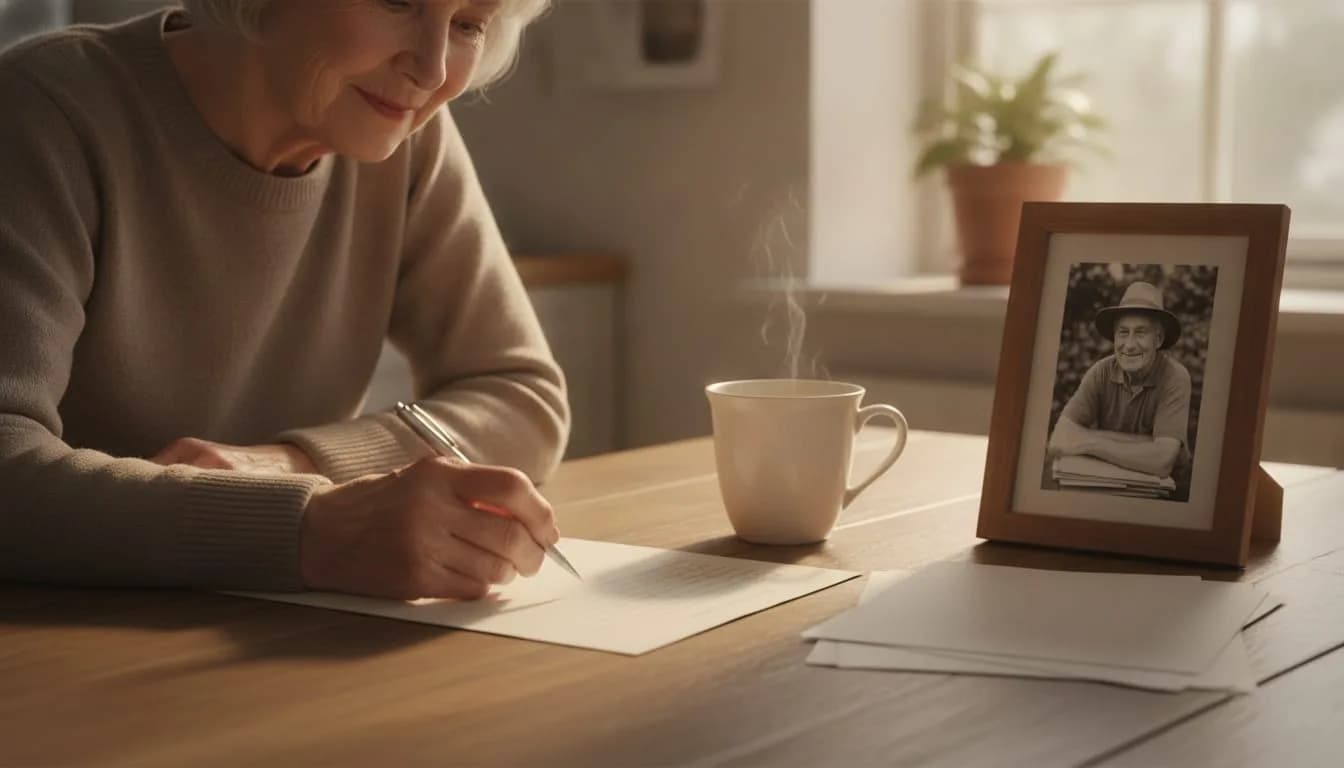
How to properly write an obituary comes down to one habit: start with a full text of about 300 words. From it you can derive a newspaper version of around 80 words, a speech of roughly two minutes and a long version for a memorial page. All the numbers are guidelines, not rules.
An obituary is a personal text that honors a life and tells who the person was. In our experience, two to three quiet hours are enough, ideally spread over two days. You don't have to get it all done at once.
Key takeaways
- A base text of about 300 words is enough as the source for every place it will appear: newspaper, funeral service and memorial page.
- In the newspaper, the size of the notice is what counts, so it pays to have a version that shrinks to around 80 words and still names one trait of the person.
- Spoken texts need shorter sentences than printed ones, because listeners can't flip back; at a calm pace, about 250 words make two minutes.
- Online there is no space limit: photos, more voices and the whole anecdote can go there, reachable through a link or QR code.
- The name, dates and service details must be right in every version, so have a second person check them before you cut.
Why the long version comes first when you write an obituary
Cutting is easier than expanding, because a long text gathers all the memories and afterwards you only have to choose. If you begin with 80 words, you have to decide what matters before you've even written it down. That often leads to stock phrases, because they take up little room.
| Version | Guideline | Where | Focus |
|---|---|---|---|
| Full | approx. 300 words | Basis for everything | Life story, character, one anecdote |
| Newspaper | approx. 80 words | Notice or obituary in the newspaper | Name, dates, one trait, service details |
| Reading aloud | approx. 250 words (two minutes) | Funeral service | Short sentences, images you can hear |
| Memorial page | 500 words and more, growing | Link or QR code | Stories, photos, voices of many people |
So the path doesn't run in one direction: two versions get shorter, while the memorial page gets longer as others add their memories.
Step 1: Write the obituary, long version first
The full version has five building blocks: an opening sentence with the name, the life story, an appreciation of the person's work and influence, a personal anecdote and a farewell with thanks. This order matches the common structure described in november.de's guide to the obituary, from the announcement of mourning to condolences and thanks.
Plan the 300 words roughly like this:
- Opening sentence, approx. 30 words: full name, date of death, age, for example “We mourn the loss of …”.
- Life story, approx. 70 words: place of birth, profession, family, one or two milestones that shaped the life.
- Work and character, approx. 80 words: What did this person do for others? What was typical of them?
- Anecdote, approx. 80 words: a small scene you can picture at once. Bestattung Wien in its guide also recommends a defining memory or quirk, so that the person feels real.
- Farewell and thanks, approx. 40 words: a sentence to those left behind, a word of thanks, a quiet ending.
Beforehand, ask three people who knew the deceased well for one sentence each in answer to: “What do you think of first?” That first thought often supplies the best anecdote. Then write without worrying about length. Better 380 words to choose from than 200 that already feel thin.
Step 2: Cut it to about 80 words for the newspaper
For the newspaper, about 80 words remain: name, date of death and age, one or two sentences on the person's character, the time and place of the funeral service and a pointer to where there is more to read. Print is charged by size; according to an overview of newspaper prices, notices are often 50 to 140 mm tall. Ask the newspaper about format and price before you cut.
Here is how to get from the long text to the short version:
- Cut the anecdote down to half a sentence, such as “She found the right book for every child”.
- Reduce the life story to one line: profession, duration, place.
- Replace adjectives like “loving” and “modest” with a detail that shows the same thing.
- Insert the funeral service details with date, time and place, and check them with the funeral home.
- Count the words. If you land between 70 and 90 words, the version fits many notice formats.
Cutting removes a lot that matters to you. That's fine: it stays in the long version, and a sentence at the end of the notice can point there.
Step 3: Adapt it for reading aloud at the funeral service
A two-minute speech comes to about 250 words when spoken calmly and solemnly, since people usually speak more slowly in times of grief than in everyday life, roughly 120 to 130 words per minute. The spoken text is therefore almost as long as the base version, but it sounds different: it needs shorter sentences and fewer numbers.
These adjustments make the text easy to read aloud:
- Sentences under about 15 words: Whoever reads aloud needs breath, and listeners can't trace back through a subordinate clause.
- Leave out dates: “On October 28, 2026, at the age of 84” becomes “Helga lived to 84”. The exact dates are in the order of service anyway.
- Speak in your own voice: “I remember” and “we” feel more natural when read aloud than “one”.
- Images instead of lists: Two scenes stay in the memory, ten qualities don't.
- Read it aloud once with a stopwatch: If you're over two and a half minutes, cut a paragraph. Mark pauses with a slash.
Print the text in a large font. With trembling hands and teary eyes, a screen is no good companion.
Step 4: Share the long version online with photos and stories
The long version gets the most room online, because there is no line price and no speaking time. On a memorial page, the base text, photos and the memories of many people sit side by side, reachable through a single link or QR code that you can print in the newspaper notice, the sympathy card or the order of service.
On WhoWasThisGuy.com, a family sets up a page where the life story, photos and memories come together. Relatives can add stories and pictures, and the page owner decides what appears. If you need help with wording, you can use the AI writing assistant, which turns keywords and memories into sentences. How you create a memorial page without losing control depends above all on this approval step.
If the family is spread across several countries, pages can be read in 15 languages. The translations are automatic and clearly labeled as such. The page costs a one-time 10 US dollars, getting started is free, and there is no subscription and no advertising. The memorial pages open soon.
Before uploading group photos, quickly ask whether everyone pictured agrees. It costs one message and saves hard feelings later.
What must never be cut
Every version must contain the full name in the form readers know it, the date of death or age, and one concrete detail that fits only this person. Everything else is negotiable. The detail is exactly what gets sacrificed first when cutting, even though it is what sets the text apart from a template.
Check every version for these points:
- Name: Have the spelling of the first name and family name read over by someone else.
- Dates: Match the date of death, age, and the time and place of the funeral service with the funeral home.
- One real detail: a garden, a sentence he always said, a dish she cooked.
- A pointer: In the newspaper, a sentence about the memorial page; in the speech, a mention of the link or QR code in the program.
Three mistakes break the process most often. First, the newspaper text is only chopped off instead of reweighted, so it ends mid-thought. Second, the speech is built from the newspaper text without checking and sounds like a notice. Third, someone publishes something about the family without agreeing it first; mention the cause of death and private details only if the relatives wish it.
Example: One obituary in three lengths
The following example is entirely made up: there is no Helga Brandt, and the dates are placeholders. It shows how the same content looks in three lengths.
Newspaper version (about 75 words):
We mourn Helga Brandt, who passed away peacefully on October 28, 2026, at the age of 84. For forty years she ran the town library and found the right book for every child. At home she had her garden, her dahlias and long letters to friends in three countries. Her warmth and dry humor stay with us. The funeral service will be held on November 6 at 11 a.m. Memories and photos can be found on her memorial page.
Reading version (excerpt, the first 40 or so words):
Helga taught us that a book is a promise. Anyone who borrowed one from her got a second one thrown in, “for the way back”. For forty years she got children reading that way. I was one of them.
The speech then continues with two more scenes, from the garden and the letters, to about 250 words, with no dates and no lists.
Memorial page (structure): The base text sits at the top, followed by the whole library story, a photo of the dahlias, a scanned letter and paragraphs from neighbors, grandchildren and friends abroad. That way the page grows beyond 500 words without anyone having to touch the newspaper text or the speech.
Frequently asked questions
How long should an obituary be?
That depends on where it appears: in the newspaper, about 80 words is often enough, at the funeral service about 250 words for two minutes, and online anything goes. Before writing, ask the newspaper for the maximum number of characters or lines, because formats and prices differ from paper to paper.
Do I have to write an obituary as a relative?
No. Friends, colleagues or a club can also write an obituary. Speak briefly with the closest relatives beforehand so that the text and the service details fit together and nobody is surprised.
Can I use the same text for the newspaper and the funeral service?
You shouldn't, because printed text is dense and full of numbers, while spoken text needs short sentences and pauses. Read the speech aloud once, ideally to someone who knew the deceased. If they stumble at a spot, rephrase it.
What do I do if I know only little about the person's life?
Write with what you know for certain, and ask relatives and friends for individual memories. On a memorial page these can be added later, so the text becomes more complete step by step.
Keep the long version safe: your next step
WhoWasThisGuy.com gives families a place where the long version, photos and the memories of all relatives stay together on one page for good, shared with a link or QR code. The cost is a one-time 10 US dollars, getting started is free, and the pages open soon.
You can begin today, without any page at all: write down five keywords about the person, ask three people for one sentence each and shape the first 300 words from them. Everything else, newspaper, speech and memorial page, follows from that, without hurry and at your own pace.
This article was prepared with the help of AI tools.