Né(e)
November 8, 1622
Nyköping, Sweden
Décédé(e)
February 13, 1660
Gothenburg, Sweden
Connu(e) pour
King of Sweden
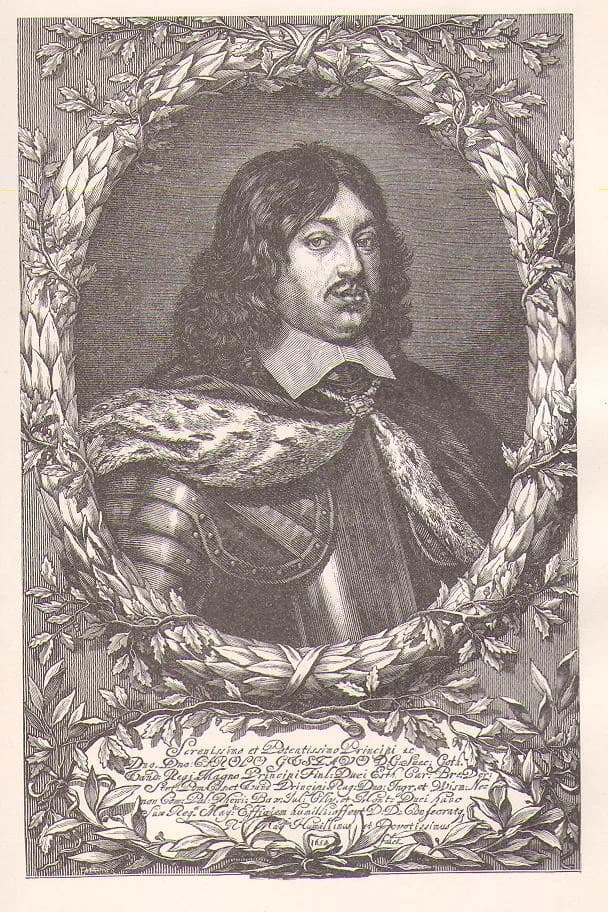
Charles X Gustav of Sweden (1622–1660) was Sweden best known for King of Sweden.
Charles X Gustav (November 8, 1622 – February 13, 1660) was a monarch from Sweden. He reigned as King from 1654, leading the nation through the Second Northern War and significantly enlarging the Swedish Empire. His tenure marked the beginning of the Swedish Caroline era, leaving a lasting impact on the nation's history.
Une vie en moments
Les moments qui ont façonné une vie




Chapitre
Chapitres de vie
Chapitre 1 · 1622· Chapitre 1 sur 8
Opening
Charles X Gustav (November 8, 1622 – February 13, 1660) was a distinguished monarch, serving as King of Sweden from 1654 until his untimely death in 1660. His reign, though relatively brief, was marked by significant military expansion and the dawn of a new era for the Swedish realm. He is remembered as a strategic leader whose actions profoundly shaped the nation's territorial reach and future direction.
Chapitre 2 · 1622· Chapitre 2 sur 8
Early Life and Origins
Born on November 8, 1622, in Nyköping, Sweden, Charles X Gustav came from a lineage deeply rooted in European nobility. He was the son of John Casimir, Count Palatine (Pfalzgraf) of Zweibrücken-Kleeburg, and Catherine of Sweden. This royal connection immediately placed him within the sphere of power and influence.
Following his father's passing, Charles X Gustav succeeded him as Pfalzgraf, a title that underscored his hereditary claim and preparation for greater responsibilities. His upbringing within this noble family prepared him for the complex political and military landscape he would later navigate as King.
Chapitre 3· Chapitre 3 sur 8
Career Beginnings
Even before officially ascending to the Swedish throne, Charles X Gustav's capabilities were recognized. His predecessor, Queen Christina, considered him the de facto Duke of Eyland (Öland). This early acknowledgement of his standing and strategic potential signaled his eventual path to leadership within the kingdom.
Chapitre 4 · 1654· Chapitre 4 sur 8
Major Achievements and Career Highlights
Charles X Gustav ascended to the Swedish throne in 1654, beginning a consequential reign that lasted until his death in 1660. He held the distinction of being the second Wittelsbach king of Sweden, following the childless king Christopher of Bavaria. His tenure also notably marked the inauguration of the Swedish Caroline era, a period of significant national development that would reach its peak under his son, Charles XI.
During his six years as monarch, Charles X Gustav led Sweden through the challenging Second Northern War. His military leadership during this conflict was instrumental in greatly enlarging the Swedish Empire, extending its influence across Northern Europe. From 1655 to 1657, he further asserted his authority by claiming the title of Grand Duke of Lithuania, reflecting the breadth of his territorial ambitions and military successes.
Chapitre 5· Chapitre 5 sur 8
Personal Life
In his personal life, Charles X Gustav was married to Hedwig Eleonora of Holstein-Gottorp. Their union provided the kingdom with an heir, as she bore his son and successor, Charles XI. This ensured the continuation of the royal line and established a clear path for future Swedish governance.
Chapitre 6· Chapitre 6 sur 8
Notable Works or Contributions
As a monarch, Charles X Gustav's primary contributions were in the realms of leadership, military strategy, and statecraft. His decisive direction of the Second Northern War stands as a testament to his military acumen, directly leading to the expansion of Swedish territories and power. He was a driving force behind the early years of the Caroline era, establishing critical precedents for governance and military focus that would define his son's powerful reign.
Chapitre 7 · 1660· Chapitre 7 sur 8
Later Years
Charles X Gustav's impactful reign concluded with his death on February 13, 1660, in Gothenburg, Sweden. Despite the relatively short duration of his time on the throne, his actions left an enduring mark on Swedish history. His passing brought an end to a period characterized by intense military campaigning and significant territorial acquisition for the nation.
Chapitre 8· Chapitre 8 sur 8
Legacy and Impact
The legacy of Charles X Gustav is firmly established in his role as a military architect and nation-builder. Through his successful campaigns in the Second Northern War, he substantially enlarged the Swedish Empire, permanently altering the geopolitical map of Northern Europe. His actions cemented Sweden's position as a dominant power during the 17th century.
Furthermore, his reign initiated the Swedish Caroline era, establishing a distinctive lineage and governmental style that would shape Sweden for decades. This period culminated in the powerful rule of his son, Charles XI, demonstrating the lasting influence of the foundations laid by Charles X Gustav.
FAQ
Questions fréquentes
Quand Charles X Gustav of Sweden est-il/elle décédé(e) ?
Charles X Gustav of Sweden est décédé(e) le 13 février 1660 à Gothenburg, Sweden, à l'âge de 37 ans.
Où est né(e) Charles X Gustav of Sweden ?
Charles X Gustav of Sweden est né(e) à Nyköping, Sweden le 8 novembre 1622.
Pour quoi Charles X Gustav of Sweden est-il/elle le/la plus connu(e) ?
Charles X Gustav of Sweden est surtout connu(e) pour King of Sweden.
Quel âge avait Charles X Gustav of Sweden à sa mort ?
Charles X Gustav of Sweden avait 37 ans au moment de son décès.
Quelle était la nationalité de Charles X Gustav of Sweden ?
Charles X Gustav of Sweden était originaire de Sweden.
Chronologie
La vie en un coup d'œil
Galerie photo
Une vie en images
Cliquez sur un polaroid pour l'agrandir · 25 photos
QR Code
Partager cette biographie
Imprimer et partager
Scannez pour visiter cette page biographique. Imprimez pour des événements, des expositions ou du matériel pédagogique.