Nascita
December 5, 1839
New Rumley, United States
Morte
June 25, 1876
Big Horn County, United States
Conosciuto per
United States cavalry commander
George Armstrong Custer (1839–1876) was United States best known for United States cavalry commander.
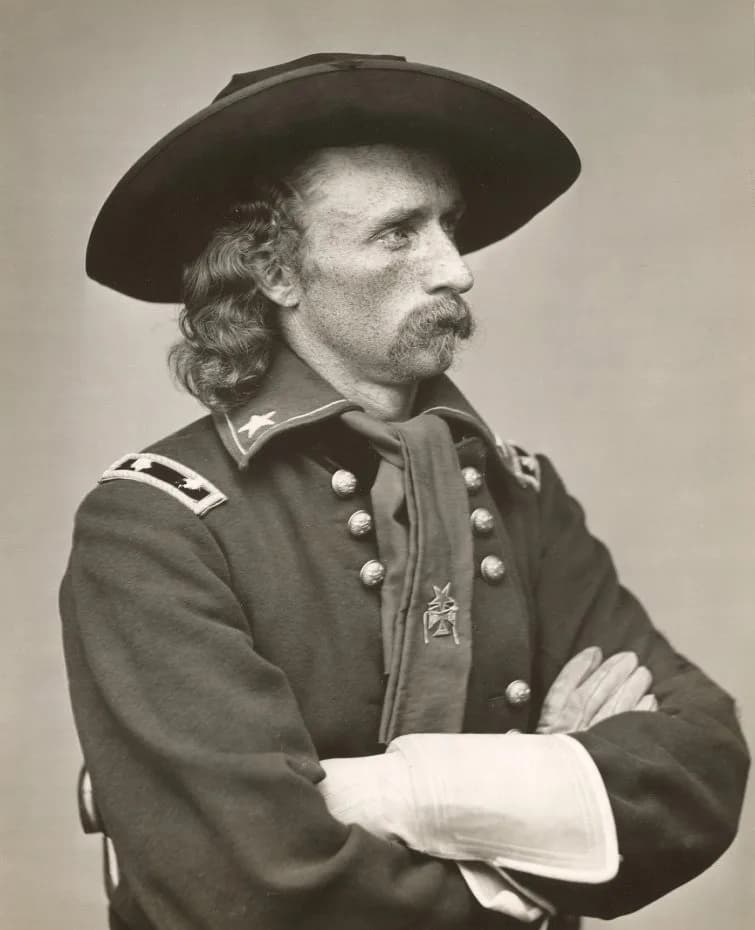
George Armstrong Custer (December 5, 1839 – June 25, 1876) was a United States Army officer and cavalry commander. Rising quickly during the Civil War, he was known for his aggressive tactics and colorful uniform. His dramatic death at the Battle of Little Bighorn cemented his controversial place in American history.
Capitolo
Capitoli di vita
Capitolo 1 · 1863· Capitolo 1 di 2
A Dashing Cavalryman Rises
Custer's meteoric rise during the American Civil War was swift. At just 23, he became a brigadier general of volunteers, commanding the Michigan Cavalry Brigade, often called the "Wolverines." He led his troops at the crucial Battle of Gettysburg in July 1863, where he defeated Confederate cavalry under General J. E. B. Stuart despite being outnumbered. His showy uniform, often seen as flamboyant, was a deliberate choice for command presence; he wanted his men to instantly spot him leading the charge into danger.
He continued to distinguish himself, serving in the Overland Campaign and later with General Philip Sheridan in the Shenandoah Valley, decisively defeating Confederate General Jubal Early at Cedar Creek. In the final days of the war in 1865, Custer's division blocked the retreat of the Army of Northern Virginia. He received the first flag of truce from the exhausted Confederates, marking his presence at General Robert E. Lee's surrender ceremony at Appomattox Court House.
Capitolo 2 · 1876· Capitolo 2 di 2
The Western Frontier and Last Stand
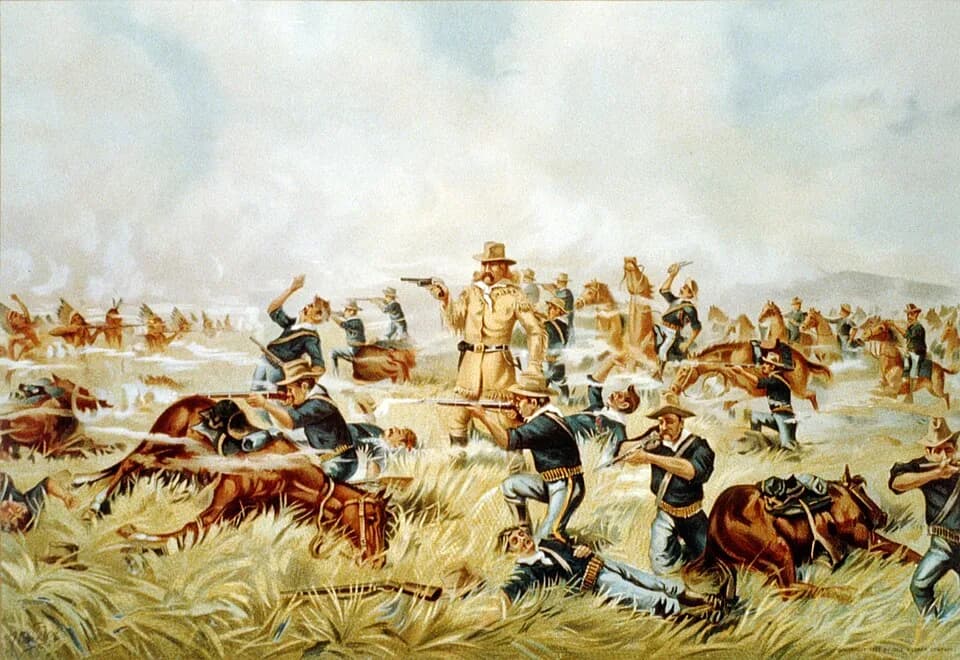
After the Civil War, Custer's military career shifted west, commissioning as a lieutenant colonel in the Regular Army. He was sent to fight in the ongoing American Indian Wars, primarily against the Lakota and other Great Plains native peoples. It was on June 25, 1876, while leading the Army's 7th Cavalry Regiment at the Battle of the Little Bighorn in the southeastern Montana Territory, that Custer, along with every soldier in his command, met his end in what became known as "Custer's Last Stand."
Custer's dramatic final chapter, much like his entire life, remains a subject of intense debate and divided opinion. For decades after his death, his adoring wife, Elizabeth Bacon "Libbie" Custer, worked tirelessly to shape his image, ensuring his mythologized status in American history through her energetic lobbying during her long widowhood, which stretched well into the 20th century.
Una vita in momenti
I momenti che hanno plasmato una vita
FAQ
Domande frequenti
Quando è morto/a George Armstrong Custer?
George Armstrong Custer è morto/a il 25 giugno 1876 a Big Horn County, United States, all'età di 36 anni.
Dove è nato/a George Armstrong Custer?
George Armstrong Custer è nato/a a New Rumley, United States il 5 dicembre 1839.
Per cosa è più conosciuto/a George Armstrong Custer?
George Armstrong Custer è più conosciuto/a per United States cavalry commander.
Quanti anni aveva George Armstrong Custer al momento della morte?
George Armstrong Custer aveva 36 anni al momento della morte.
Di che nazionalità era George Armstrong Custer?
George Armstrong Custer era originario/a di United States.
Cronologia
La vita in sintesi
Galleria fotografica
Una vita in immagini
Clicca su una polaroid per ingrandirla · 21 foto
Codice QR
Condividi questa biografia
Stampa e Condividi
Scansiona per visitare questa pagina biografica. Stampa per eventi, mostre o materiali didattici.