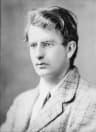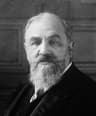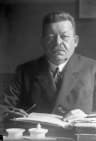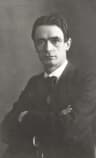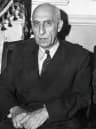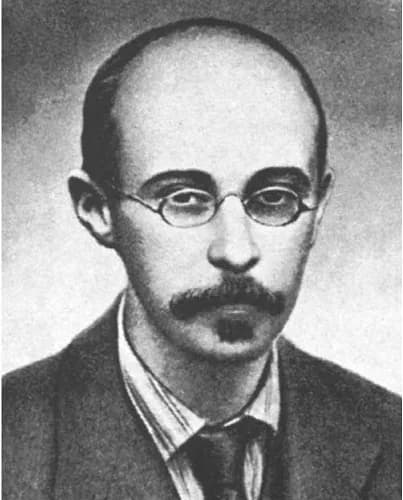
Born
June 16, 1888
Saint Petersburg, Russia
Died
September 16, 1925
Saint Petersburg, Russia
Known for
Russian mathematician
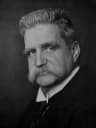
Alexander Friedmann (1888–1925) was Russia best known for Russian mathematician.
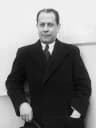
Alexander Friedmann (June 16, 1888 – September 16, 1925) was a Russian mathematician from Saint Petersburg, Russia. He originated the pioneering theory that the universe is expanding, developing the Friedmann equations. His work laid the foundation for modern cosmology.
Chapter
Life chapters
Chapter 1 · 1888· Chapter 1 of 7
Introduction: A Visionary Mind
Today, we remember Alexander Friedmann, a brilliant Russian mathematician whose life, though tragically short, left an enduring legacy in the fields of physics and cosmology. Born on June 16, 1888, and passing on September 16, 1925, Friedmann's work profoundly reshaped our understanding of the cosmos.
He was a scientist, mathematician, physicist, and meteorologist, known primarily for his groundbreaking theory of an expanding universe. His contributions continue to influence scientific thought and inspire new generations of researchers.
Chapter 2 · 1888· Chapter 2 of 7
Early Life and Origins
Alexander Friedmann was born in Saint Petersburg, Russia, a vibrant cultural and scientific center, on June 16, 1888. His early years in this historic city likely fostered an environment ripe for intellectual growth and scientific inquiry.
Details of his family and early upbringing are not provided, but his later academic achievements suggest a strong foundation in education. He dedicated his life to scientific pursuits from an early age, establishing himself as a keen observer and a deep thinker.
Chapter 3· Chapter 3 of 7
Career Beginnings
Friedmann embarked on a versatile career path, engaging with multiple scientific disciplines. He was recognized as a scientist, mathematician, physicist, and meteorologist, showcasing a broad range of expertise and interests.
His early work would have built upon the scientific rigor prevalent in Russian academic circles at the turn of the 20th century. These initial explorations in various fields undoubtedly prepared him for the complex theoretical work that would later define his career.
Chapter 4· Chapter 4 of 7
Major Achievements and Career Highlights
Friedmann’s most significant contribution was his pioneering theory that the universe is expanding, a concept that revolutionized cosmological thought. This theory provided a dynamic alternative to the static universe model prevalent at the time.
He developed a set of equations, now famously known as the Friedmann equations, which mathematically described this expansion. These equations laid the theoretical groundwork for what would become the Big Bang theory, offering a mathematical framework for understanding the universe's evolution.
His insights as a physicist and mathematician enabled him to construct a coherent model of the universe's geometry and dynamics. This pivotal work was achieved despite the relatively nascent state of cosmology in the early 20th century.
Chapter 5· Chapter 5 of 7
Personal Life
While Alexander Friedmann's professional life was marked by significant scientific achievements, specific details regarding his personal life, family, relationships, or hobbies are not available in the provided information. His legacy is predominantly defined by his intellectual contributions.
Chapter 6 · 1925· Chapter 6 of 7
Later Years
Alexander Friedmann's life was cut short too soon; he passed away on September 16, 1925, in his birth city of Saint Petersburg, Russia. He was only 37 years old, leaving behind a wealth of ideas and an unfinished scientific journey.
Despite his untimely death, the impact of his work continued to grow in the decades that followed. His passing marked the end of a brilliant individual's journey, but the beginning of his ideas' widespread acceptance and exploration.
Chapter 7· Chapter 7 of 7
Legacy and Impact
Alexander Friedmann's theory of an expanding universe fundamentally altered the course of modern cosmology. His Friedmann equations remain a cornerstone for understanding the universe's dynamics and large-scale structure.
Subsequent observations, particularly by Edwin Hubble, later provided empirical evidence supporting Friedmann's theoretical predictions. Today, every discussion about the universe's origin and evolution owes a debt to his courageous and innovative thinking. His intellectual vision continues to inspire physicists and mathematicians globally.
A life in moments
The moments that shaped a life
FAQ
Frequently asked
When did Alexander Friedmann die?
Alexander Friedmann died on September 16, 1925 in Saint Petersburg, Russia, at the age of 37.
Where was Alexander Friedmann born?
Alexander Friedmann was born in Saint Petersburg, Russia on June 16, 1888.
What is Alexander Friedmann best known for?
Alexander Friedmann is best known for Russian mathematician.
How old was Alexander Friedmann when they died?
Alexander Friedmann was 37 years old at the time of death.
What nationality was Alexander Friedmann?
Alexander Friedmann was from Russia.
Timeline
Life at a glance
Photo gallery
A life in pictures
Click any polaroid to expand · 14 photos
QR Code
Share This Biography
Print & Share
Scan to visit this biography page. Print for events, exhibitions, or educational materials.