Ur.
August 1, 1924
Dubrovytsia, Ukraine
Zm.
September 29, 2010
Paris, France
Znany/a z
French physicist
Georges Charpak (1924–2010) was Ukraine best known for French physicist.
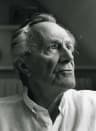
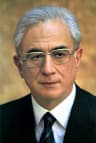
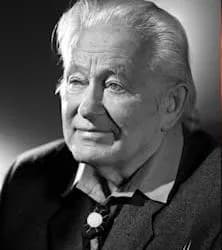
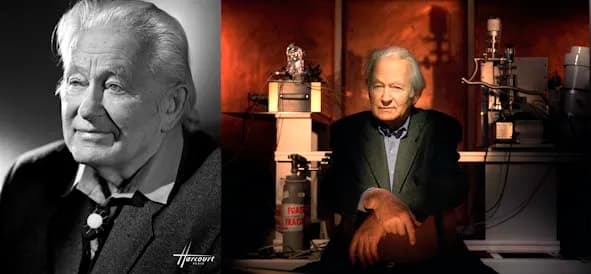
Georges Charpak (August 1, 1924 – September 29, 2010) was a French physicist from Dubrovytsia, Ukraine. He received the Nobel Prize in Physics in 1992 for his invention of the multiwire proportional chamber. His work revolutionized particle detection in physics.
Rozdział
Rozdziały życia
Rozdział 1 · 1924· Rozdział 1 z 6
Early Life and Origins
Georges Charpak's life began in Dubrovytsia, Ukraine, where he was born on August 1, 1924. His early life was set against a backdrop of significant geopolitical change in Eastern Europe. He was described as a Polish-born French physicist, indicating a profound journey that saw him transition from his birth country to become a prominent scientific citizen of France.
Rozdział 2· Rozdział 2 z 6
Career Beginnings
Before his illustrious career in physics, Georges Charpak demonstrated remarkable bravery as a French resistance fighter. This period underscored his profound commitment and resilience. After the war, he channeled his intellect and determination into the field of physics, laying the groundwork for his future innovations and scientific advancements.
Rozdział 3· Rozdział 3 z 6
Major Achievements and Career Highlights
Charpak's most significant contribution to science was the invention and development of the multiwire proportional chamber. This revolutionary particle detector transformed experimental particle physics. His work on this device significantly enhanced the ability of scientists to track and measure subatomic particles with unprecedented precision.
Rozdział 4· Rozdział 4 z 6
Notable Works or Contributions
The multiwire proportional chamber, developed by Charpak, represented a quantum leap in particle detection technology. This innovative device provided faster and more accurate information about the trajectories of elementary particles. Its development allowed physicists to conduct more complex and precise experiments, opening new avenues for understanding the fundamental building blocks of the universe.
Rozdział 5 · 1992· Rozdział 5 z 6
Later Years
The culmination of Georges Charpak's scientific endeavors was recognized in 1992, when he was awarded the Nobel Prize in Physics. This prestigious honor celebrated his invention and development of particle detectors, particularly the multiwire proportional chamber. He continued to contribute to the scientific community until his passing in Paris, France, on September 29, 2010.
Rozdział 6· Rozdział 6 z 6
Legacy and Impact
Georges Charpak's multiwire proportional chamber fundamentally changed the field of experimental particle physics. His invention became an indispensable tool in laboratories worldwide, enabling new discoveries and advancing our understanding of the universe. His legacy lives on through the continued use and evolution of his detector technology, inspiring generations of physicists to push the boundaries of knowledge.
Życie w chwilach
Chwile, które ukształtowały życie
FAQ
Często zadawane pytania
Kiedy zmarł(a) Georges Charpak?
Georges Charpak zmarł(a) 29 września 2010 w Paris, France w wieku 86 lat.
Gdzie urodził(a) się Georges Charpak?
Georges Charpak urodził(a) się w Dubrovytsia, Ukraine 1 sierpnia 1924.
Z czego najbardziej znany(a) jest Georges Charpak?
Georges Charpak jest najbardziej znany(a) z French physicist.
Ile lat miał(a) Georges Charpak w chwili śmierci?
Georges Charpak miał(a) 86 lat w chwili śmierci.
Jakiej narodowości był(a) Georges Charpak?
Georges Charpak pochodził(a) z Ukraine.
Oś czasu
Życie w skrócie
Galeria zdjęć
Życie w obrazach
Kliknij dowolny polaroid, by go powiększyć · 24 zdjęć
Kod QR
Udostępnij tę biografię
Drukuj i udostępnij
Zeskanuj, aby odwiedzić tę stronę biografii. Wydrukuj na wydarzenia, wystawy lub materiały edukacyjne.