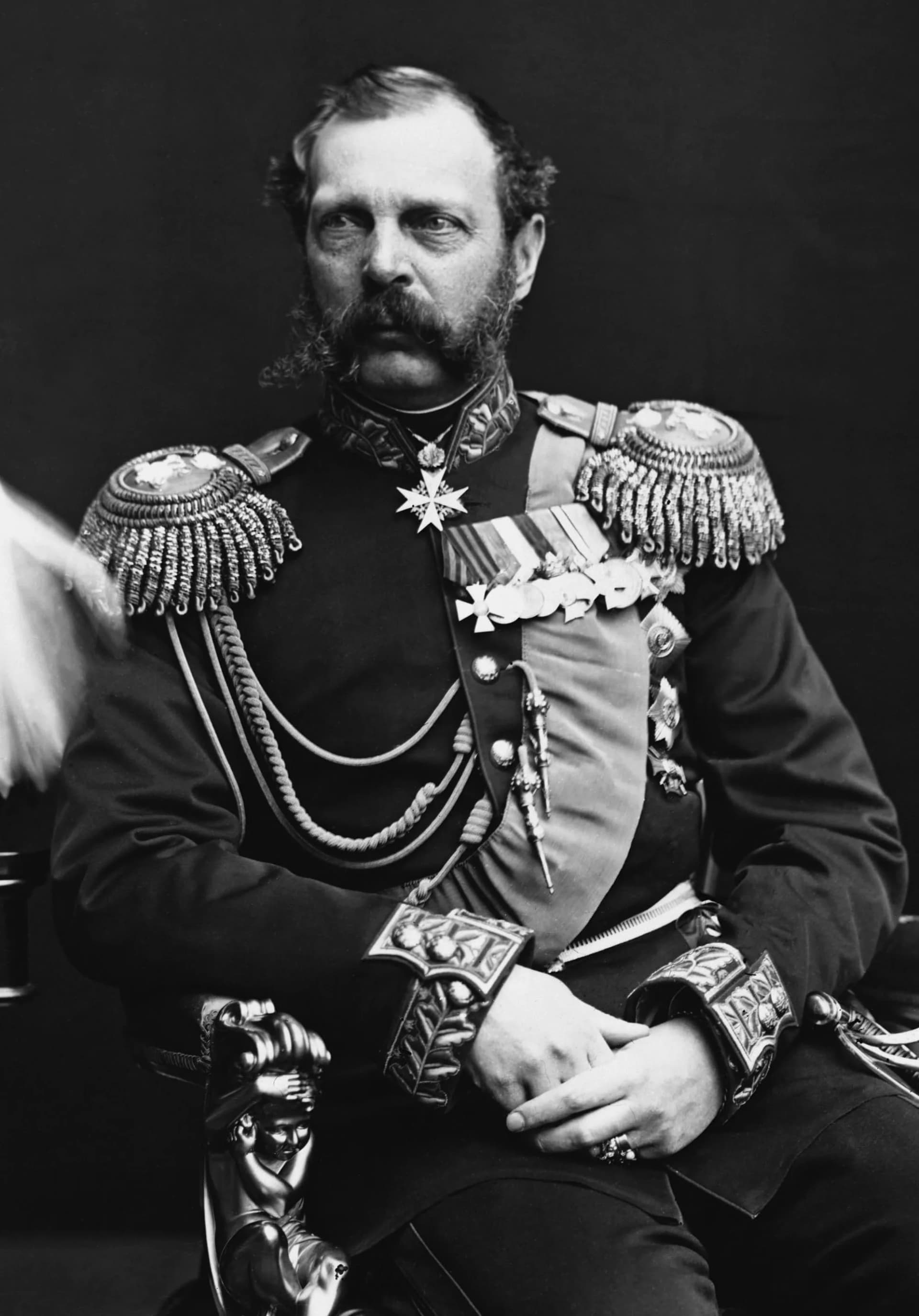
Geboren
April 29, 1818
Small Nicholas Palace, Russia
Overleden
March 13, 1881
Winter Palace, Russia
Bekend om
The 12th Emperor of Russia
Alexander II of Russia (1818–1881) was Russia best known for The 12th Emperor of Russia.
Alexander II of Russia (April 29, 1818 – March 13, 1881) was a monarch, statesperson, and ruler from Russia. He is celebrated as Alexander the Liberator for abolishing serfdom in 1861 with his historic Edict of Emancipation. His reign marked a significant period of reform for the nation.
Hoofdstuk
Levenshoofdstukken
Hoofdstuk 1 · 1818· Hoofdstuk 1 van 8
Opening Tribute
Alexander II of Russia (April 29, 1818 – March 13, 1881) was a monarch, statesperson, and ruler who served as the 12th Emperor of Russia. His reign, spanning from March 2, 1855, until his assassination in 1881, is particularly noted for significant reforms within the Russian Empire. He is historically recognized as Alexander the Liberator, a title earned through his momentous Edict of Emancipation.
This pivotal edict officially abolished serfdom across Russia in 1861, marking a profound change in the nation's social and economic structure. Alexander II’s actions reshaped the lives of millions and set a new course for the future of Russia. His legacy remains a central subject of study in Russian history.
Hoofdstuk 2 · 1818· Hoofdstuk 2 van 8
Early Life and Origins
Born on April 29, 1818, Alexander II entered the world at the Small Nicholas Palace in Russia. As the eldest son of Nicholas I, he was destined from birth for the imperial throne. His upbringing was meticulously designed to prepare him for the immense responsibilities of leading a vast empire.
His early education focused on subjects crucial for a future monarch, including statesmanship, military strategy, and European languages. These formative years within the imperial court instilled in him a deep understanding of Russian society and the duties associated with his royal lineage.
Hoofdstuk 3 · 1855· Hoofdstuk 3 van 8
Career Beginnings
Alexander II succeeded his father, Nicholas I, as Emperor of Russia on March 2, 1855. His ascension to power also made him the King of Poland and Grand Duke of Finland, reflecting the extensive reach of the Russian Empire. The official coronation ceremony took place on September 7, 1856, solidifying his position as the supreme ruler.
Assuming leadership at a challenging time, Alexander II immediately faced the task of addressing long-standing societal issues and consolidating his authority. His early years as emperor were characterized by careful consideration of the empire's internal and external affairs, setting the stage for future policy decisions.
Hoofdstuk 4 · 1861· Hoofdstuk 4 van 8
Major Achievements and Career Highlights
The defining achievement of Alexander II's reign was the Edict of Emancipation, which he issued in 1861. This historic act abolished serfdom throughout the Russian Empire, freeing millions of serfs from their feudal bonds. This monumental reform earned him the enduring title of Alexander the Liberator.
Beyond the abolition of serfdom, his administration implemented various other reforms, though the Edict remains his most recognized contribution. These reforms aimed to modernize Russia and address some of the entrenched issues that had plagued the nation for centuries. His actions demonstrated a commitment to internal change and social development.
Hoofdstuk 5· Hoofdstuk 5 van 8
Personal Life
Alexander II's personal life, though largely defined by his imperial duties, included his family and succession. He was succeeded by his son, Alexander III, who continued the Romanov dynasty. The continuity of the imperial line was a crucial aspect of his role as Emperor.
Hoofdstuk 6 · 1861· Hoofdstuk 6 van 8
Notable Works or Contributions
The Edict of Emancipation of 1861 stands as Alexander II's singular and most impactful contribution. This legal document fundamentally altered the social structure of Russia, moving it away from a system of hereditary servitude. It granted personal freedom to over 23 million serfs, along with land allotments, albeit with associated redemption payments.
The Edict represented a bold step towards modernizing Russia and addressing the moral and economic inefficiencies of serfdom. Its implementation was complex and generated significant social changes, resonating throughout Russian society for generations. This act remains a central focus when discussing his reign.
Hoofdstuk 7 · 1881· Hoofdstuk 7 van 8
Later Years
Alexander II’s reign, though marked by significant reforms, ended tragically. He was assassinated on March 13, 1881, in St. Petersburg, Russia. The attack occurred near the Winter Palace, the very place of his death.
His assassination brought an abrupt end to a period of reform and ushered in a new era under his son, Alexander III. The violent culmination of his life underscores the turbulent political climate of late 19th-century Russia.
Hoofdstuk 8 · 1861· Hoofdstuk 8 van 8
Legacy and Impact
Alexander II's legacy is intrinsically linked to his role as Alexander the Liberator and the abolition of serfdom. His courageous decision in 1861 set Russia on an irreversible path of social and economic change. This act alone secured his place as one of the most significant figures in Russian history.
His reign is remembered for the ambition of its reforms, which aimed to bring Russia into a new age. Though his life ended violently, the impact of his emancipatory policies continued to shape the development of the Russian Empire for decades to come, affecting millions of lives and the very fabric of the nation.
Een leven in momenten
De momenten die een leven hebben gevormd
Veelgestelde vragen
Veelgestelde vragen
Wanneer is Alexander II of Russia overleden?
Alexander II of Russia overleed op 13 maart 1881 in Winter Palace, Russia op 62-jarige leeftijd.
Waar werd Alexander II of Russia geboren?
Alexander II of Russia werd geboren in Small Nicholas Palace, Russia op 29 april 1818.
Waar is Alexander II of Russia het meest bekend om?
Alexander II of Russia is het meest bekend om The 12th Emperor of Russia.
Hoe oud was Alexander II of Russia bij overlijden?
Alexander II of Russia was 62 jaar oud op het moment van overlijden.
Wat was de nationaliteit van Alexander II of Russia?
Alexander II of Russia kwam uit Russia.
Tijdlijn
Een leven in een oogopslag
Fotogalerij
Een leven in beelden
Klik op een polaroid om uit te vergroten · 24 foto's
QR-code
Deel deze biografie
Afdrukken en delen
Scan om deze biografiepagina te bezoeken. Druk af voor evenementen, tentoonstellingen of educatief materiaal.