
Geboren
May 4, 1008
Reims, France
Verstorben
August 4, 1060
Vitry-aux-Loges, France
Bekannt für
king of the Franks from 1031 to 1060
Henry I of France (1008–1060) was France best known for king of the Franks from 1031 to 1060.
Henry I of France (May 4, 1008 – August 4, 1060) was a king of the Franks from Reims. Reigning from 1031 to 1060, he skillfully navigated the complexities of feudal power, at times supporting and at times opposing formidable vassals like William the Conqueror. His reign is noted for the challenges it posed to early Capetian royal authority.
Kapitel
Lebenskapitel
Kapitel 1 · 1047· Kapitel 1 von 2
A King's Shifting Alliances
Henry's reign was largely defined by his dynamic relationship with the powerful dukes and counts surrounding him. In an early strategic masterstroke, he came to the aid of his young nephew-in-law, William of Normandy, helping to quell a significant revolt by William's own vassals. Their decisive victory at the Battle of Val-ès-Dunes in 1047 secured the duchy for William. This was a king capable of decisive action.
However, the shifting sands of power meant alliances were rarely permanent. William, who would later be known as the Conqueror, married Henry's niece Matilda. This union soon transformed a useful ally into a perceived threat. Henry invaded Normandy twice, in 1054 and again in 1057, but suffered defeats at the battles of Mortemer and Varaville. His efforts to contain his powerful vassal continued until the very end of his life.
Kapitel 2 · 1056· Kapitel 2 von 2
Diplomacy and Defiance
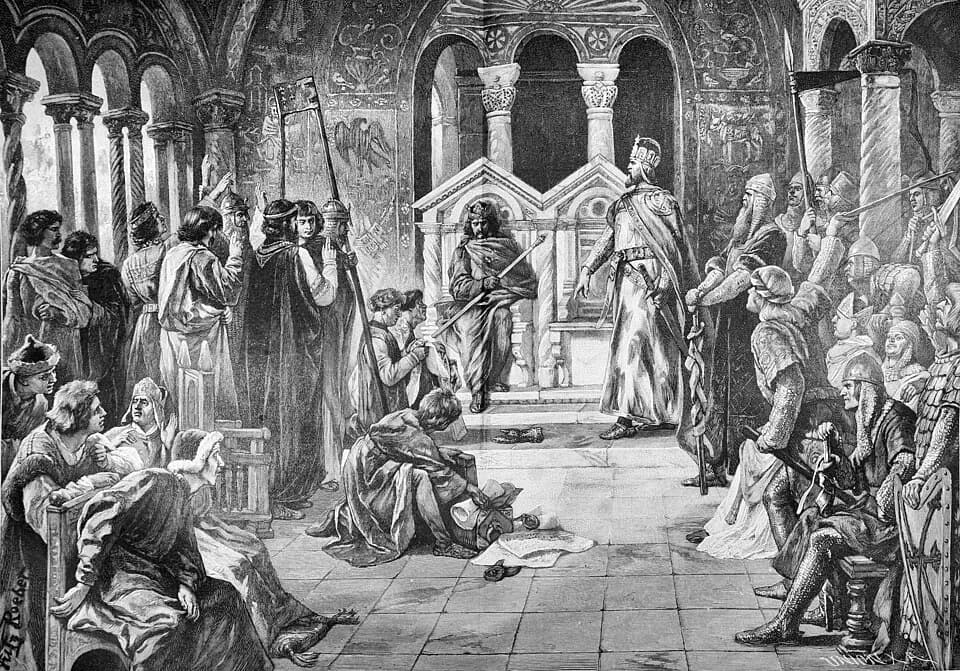
Beyond internal conflicts, Henry I also engaged with the wider European stage. He held three significant meetings with Henry III, the Holy Roman Emperor, all at Ivois. These summits addressed everything from royal marriages to boundary disputes. While the early meetings forged a treaty of friendship, their final encounter in 1056 escalated into a heated debate over the County of Blois, with Henry I accusing the Emperor of breach of contract before dramatically leaving the discussion.
His reign also saw him challenge the growing influence of the Church. In 1058, Henry openly sold bishoprics and abbacies, shrugging off accusations of simony and tyranny from the Papal legate Cardinal Humbert. This defiance highlighted a king determined to assert royal authority even against powerful ecclesiastical claims. In 1060, he took the time to rebuild the Saint-Martin-des-Champs Priory just outside Paris, a gesture of royal patronage amidst constant political strife.
Henry I died on August 4, 1060, still engaged in the fray, besieging Thimert, which had been occupied by the Normans. He was succeeded by his young son, Philip I, with his queen, Anne of Kiev, taking on the crucial role of regent. He was laid to rest in the Basilica of St Denis, leaving behind a legacy not of static power, but of relentless, realistic kingship in a turbulent age.
Ein Leben in Momenten
Die Momente, die ein Leben prägten

FAQ
Häufig gefragt
Wann starb Henry I of France?
Henry I of France starb am 4. August 1060 in Vitry-aux-Loges, France im Alter von 52 Jahren.
Wo wurde Henry I of France geboren?
Henry I of France wurde in Reims, France am 4. Mai 1008 geboren.
Wofür ist Henry I of France am bekanntesten?
Henry I of France ist am bekanntesten für king of the Franks from 1031 to 1060.
Wie alt war Henry I of France beim Tod?
Henry I of France war zum Zeitpunkt des Todes 52 Jahre alt.
Welche Nationalität hatte Henry I of France?
Henry I of France stammte aus France.
Zeitlinie
Leben im Überblick
Fotogalerie
Ein Leben in Bildern
Klicken Sie ein Polaroid an, um es zu vergrößern · 43 Fotos
QR-Code
Diese Biografie teilen
Drucken & Teilen
Scannen Sie, um diese Biografieseite zu besuchen. Drucken Sie sie für Veranstaltungen, Ausstellungen oder Lehrmaterialien.