Born
April 25, 1874
Bologna, Italy
Died
July 20, 1937
Rome, Italy
Known for
Italian inventor and radio pioneer
Guglielmo Marconi (1874–1937) was Italy best known for Italian inventor and radio pioneer.
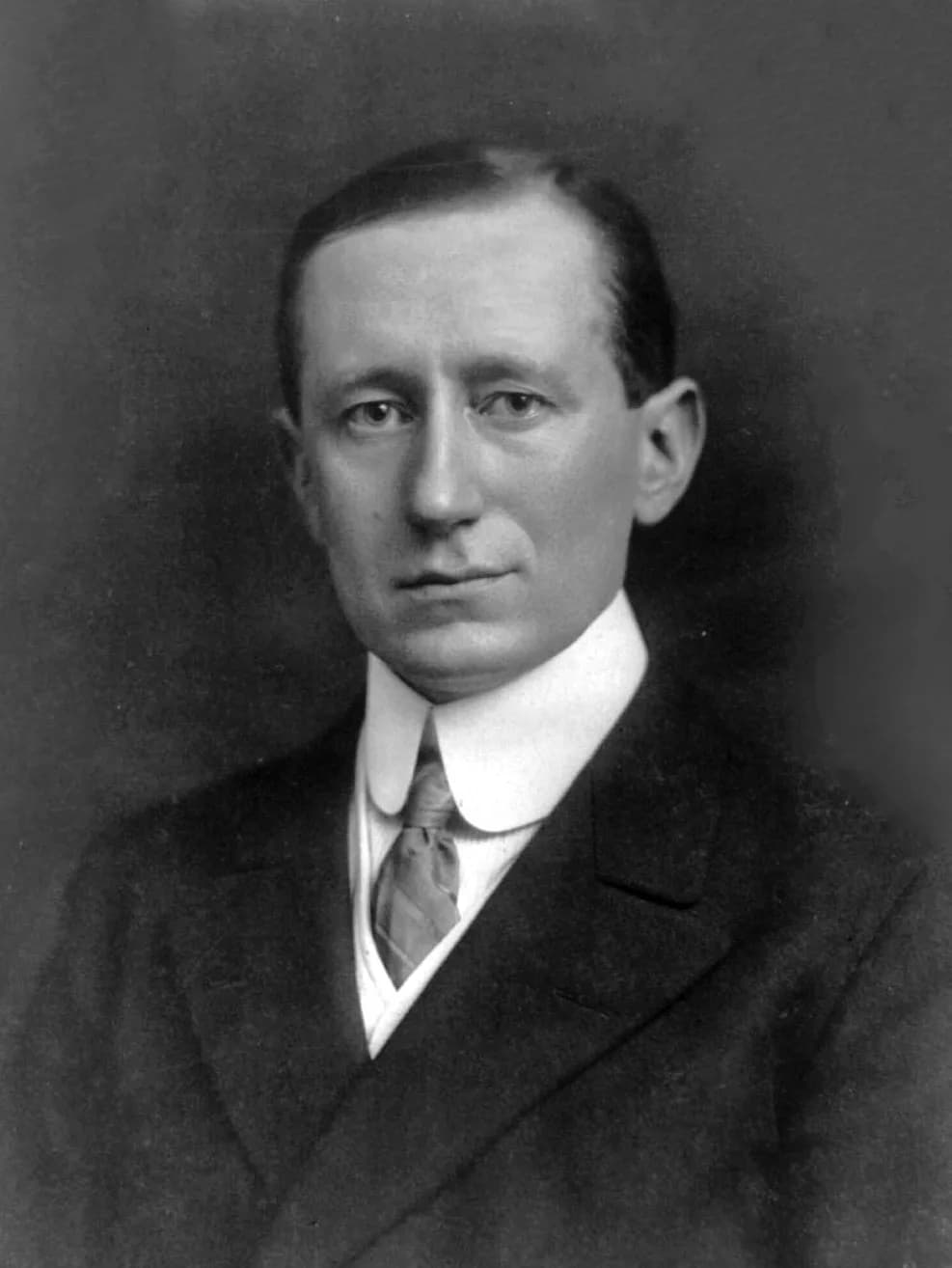
Guglielmo Marconi (April 25, 1874 – July 20, 1937) was an Italian inventor and radio pioneer. He is largely credited for creating a practical radio wave-based wireless telegraph system. This work earned him a share of the 1909 Nobel Prize in Physics and significantly shaped modern wireless communication.
Chapter
Life chapters
Chapter 1 · 1874· Chapter 1 of 8
Opening
Guglielmo Giovanni Maria Marconi (April 25, 1874 – July 20, 1937) was an Italian inventor and radio pioneer, whose visionary work fundamentally reshaped global communication. His significant contributions as a scientist, engineer, businessperson, politician, physicist, and inventor laid the groundwork for modern wireless technology. Born in Bologna, Italy, Marconi’s life was dedicated to harnessing the power of electromagnetic waves. This tireless pursuit culminated in the creation of the practical radio wave-based wireless telegraph system, a breakthrough that transformed the world. Through his ingenuity, he became largely credited as the inventor of radio, forever changing how people connect across distances and earning him enduring recognition.
Chapter 2 · 1874· Chapter 2 of 8
Early Life and Origins
Guglielmo Marconi was born on April 25, 1874, in the historic city of Bologna, Italy. His early environment in Italy was one that fostered curiosity and an independent spirit, which proved crucial for his later scientific pursuits. Even as a young man, Marconi exhibited a deep interest in the emerging field of electricity and the principles of physics. These formative experiences in his birthplace of Bologna undoubtedly influenced his later dedication to experimentation and the relentless pursuit of innovative solutions in communication technology. He spent his youth observing and learning, laying a foundation for the groundbreaking work that would define his adult life.
Chapter 3· Chapter 3 of 8
Career Beginnings
Marconi's career truly began with his fervent ambition to develop a practical method for communicating without wires. He was deeply inspired by earlier experiments with electromagnetic waves and sought to turn theoretical concepts into a functional system. His initial work focused on adapting and improving existing technologies, particularly those related to Hertzian waves, into a robust wireless telegraphy apparatus. This pioneering effort required immense dedication, as he meticulously worked to refine transmitters, receivers, and antennas capable of reliable long-distance signal transmission. These early experiments paved the way for the creation of a fully functional radio wave-based wireless telegraph system, an endeavor that marked the commencement of his monumental contributions to science and engineering.
Chapter 4 · 1909· Chapter 4 of 8
Major Achievements and Career Highlights
Guglielmo Marconi's most significant achievement was undeniably the successful creation of a practical radio wave-based wireless telegraph system. This invention revolutionized communication, allowing messages to traverse vast distances, including oceans, without physical connections. His tireless work earned him widespread acclaim and solidified his place in history as a preeminent innovator in the field of electrical engineering. In recognition of their unparalleled contributions to the development of wireless telegraphy, Marconi shared the prestigious 1909 Nobel Prize in Physics with Ferdinand Braun. This global acknowledgment from the Nobel Committee solidified his status as a leading scientist and engineer, celebrating his transformative impact on technology. Beyond his inventive genius, Marconi also excelled in various professions, serving as a scientist, physicist, businessperson, and even a politician, demonstrating the breadth of his influence and capabilities. His journey from an aspiring inventor in Bologna to a Nobel laureate showcased a career filled with groundbreaking milestones.
Chapter 5· Chapter 5 of 8
Personal Life
While Guglielmo Marconi's professional life was extensively documented through his scientific endeavors and political engagements, specific intimate details regarding his personal family life, relationships, or private interests are not extensively detailed in the provided information. His dedication to his monumental work in wireless communication often characterized his public existence. The available records primarily highlight his groundbreaking professional journey and the significant influence of his contributions to the field of science and technology. Despite his public persona as a renowned inventor, aspects of his personal world remain largely outside the scope of the provided biographical data.
Chapter 6 · 2018· Chapter 6 of 8
Notable Works or Contributions
Marconi's central and most enduring contribution was his practical radio wave-based wireless telegraph system, a truly revolutionary advancement in communication technology. He is widely and deservedly credited as the inventor of radio, a title that reflects his successful and persistent efforts to transform theoretical principles into a universally applicable and reliable method of wireless communication. This groundbreaking invention significantly impacted maritime safety, military communication, and eventually laid the essential groundwork for public broadcasting and personal wireless devices. It is imperative to clarify that the academic publications list provided, including titles such as "AFFECTIVE AGILE DESIGN A PROPOSAL FOR A NEW SOFTWARE DEVELOPMENT MODEL" (2018), "Comparative Evaluation of Fuzzy Axiomatic Design and IAMS Comprehensive VIKOR Approaches for Material Selection in Mechanical Design" (2020), "Collaborative learning and 3D virtual worlds: two experiences in a new didactic perspective" (2015), "Authoritarianism and totalitarianism A case study of multimedia and interdisciplinary teaching" (2019), and "Remote laboratories for practical experiments on renewable energies at European universities" (2023), are not attributed to Guglielmo Marconi (1874-1937). These entries distinctly relate to a different academic with the same name, as unequivocally evidenced by their publication dates, which occurred many decades after Marconi's passing in 1937. His true works are embodied in the foundational patents and practical applications of his wireless telegraphy system.
Chapter 7 · 1937· Chapter 7 of 8
Later Years
Guglielmo Marconi continued his significant work in the field of radio and wireless technology throughout the remainder of his life, never ceasing his exploration of new frontiers. His innovative spirit remained vibrantly active, as he consistently explored new possibilities and refinements for the revolutionary technology he had pioneered decades earlier. He dedicated his final years to further research and development, ensuring that his inventions continued to evolve and expand their utility. Guglielmo Marconi passed away peacefully on July 20, 1937, in Rome, Italy, at the age of 63. His death marked the conclusion of a life extraordinarily dedicated to scientific exploration, technological advancement, and the great advancement of global communication for humanity.
Chapter 8 · 1909· Chapter 8 of 8
Legacy and Impact
Guglielmo Marconi's legacy is immense and undeniably foundational, fundamentally shaping the very fabric of the modern world. His groundbreaking invention of the practical radio wave-based wireless telegraph system laid the essential foundation for virtually all forms of wireless communication systems we utilize today, from broadcasting to mobile phones and satellite communications. The prestigious Nobel Prize in Physics, which he shared in 1909, serves as powerful evidence of the unparalleled scientific significance and transformative power of his contributions to wireless telegraphy. Marconi's pioneering efforts as an inventor, scientist, and engineer continue to inspire countless new generations of researchers and innovators across various scientific disciplines. The enduring impact of his work, from enabling transatlantic communication to creating the initial framework for global broadcasting, remains absolutely central to contemporary global connectivity and technological progress. His vision forever changed how humanity communicates, making the world a much smaller and more interconnected place.
A life in moments
The moments that shaped a life

FAQ
Frequently asked
When did Guglielmo Marconi die?
Guglielmo Marconi died on July 20, 1937 in Rome, Italy, at the age of 63.
Where was Guglielmo Marconi born?
Guglielmo Marconi was born in Bologna, Italy on April 25, 1874.
What is Guglielmo Marconi best known for?
Guglielmo Marconi is best known for Italian inventor and radio pioneer.
How old was Guglielmo Marconi when they died?
Guglielmo Marconi was 63 years old at the time of death.
What nationality was Guglielmo Marconi?
Guglielmo Marconi was from Italy.
Timeline
Life at a glance
Photo gallery
A life in pictures
Click any polaroid to expand · 23 photos
QR Code
Share This Biography
Print & Share
Scan to visit this biography page. Print for events, exhibitions, or educational materials.