Tug'ilgan
December 7, 1081
Paris, France
Vafot etgan
August 8, 1137
Château de la Douye, France
Mashhur bo'lgan
king of the Franks from 1108 to 1137
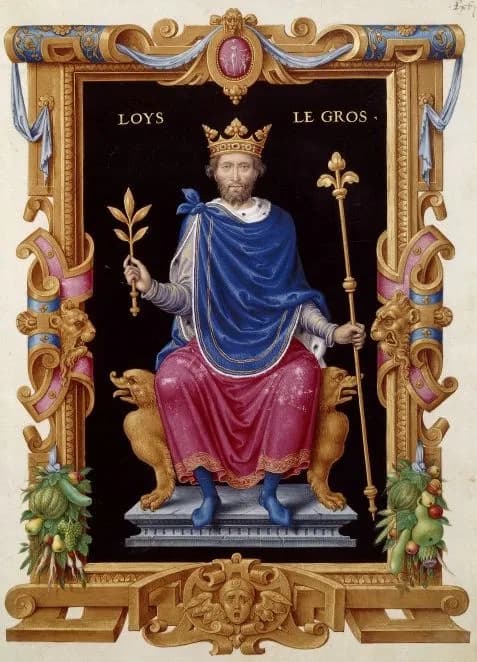
Louis VI of France (1081-1137) was King of the Franks from 1108 to 1137. Known as "the Fat" or "the Fighter," he centralized royal power and fought against lawless nobles throughout his twenty-nine-year reign. His legal innovations established foundations for unified French governance.
Bob
Hayot bo'limlari
Bob 1 · 1081· 7 bobdan 1-bobi
Early Life and Origins
Born on December 7, 1081, in Paris, France, Louis VI entered the world as the son of Philip I of France, inheriting a legacy of royal ambition and political challenges. Growing up in the royal court during the late 11th century, he witnessed firsthand the struggles his father faced in maintaining control over rebellious vassals and competing claims to French territories. The young prince's upbringing in Paris, the heart of the Capetian kingdom, provided him with intimate knowledge of the political dynamics that would later inform his approach to kingship.
Bob 2 · 1108· 7 bobdan 2-bobi
Rise to the Throne
Louis VI ascended to the throne in 1108, inheriting a kingdom plagued by internal disorder and external threats. His early years as king were marked by the immediate need to address the chaos caused by "robber barons" who had turned the Île de France into their personal battleground. Unlike many of his predecessors who ruled from a distance, Louis chose to personally engage with these challenges, earning his reputation as "the Fighter" through direct military intervention against lawless knights.
Bob 3· 7 bobdan 3-bobi
Major Achievements and Military Campaigns
The new king's most significant achievement lay in his systematic campaign against the robber barons who had terrorized the French countryside for decades. He personally led military expeditions throughout the Île de France, bringing lawless knights to justice through force when necessary. His approach was both practical and revolutionary, as he demonstrated that royal authority could be enforced through direct action rather than mere proclamation.
Louis VI also engaged in prolonged conflicts with Henry I of England over the English continental possessions in Normandy. These campaigns, while costly and demanding, established France as a formidable opponent to English expansion on the continent. Through these military efforts, he managed to reinforce his influence considerably, proving that the French monarchy could compete with its powerful neighbors.
Bob 4· 7 bobdan 4-bobi
Legal and Administrative Innovations
Perhaps Louis VI's most lasting contribution came through his work in centralizing the institutions of royal power, following in the footsteps of his father Philip I. He became the first member of the House of Capet to issue ordonnances that applied to the entire kingdom of France, establishing legal precedents that extended royal authority beyond traditional feudal boundaries. These administrative innovations created a foundation for unified French law that would influence legal development for generations.
Bob 5· 7 bobdan 5-bobi
Personal Character and Leadership Style
Known for his hands-on approach to governance, Louis VI distinguished himself from other medieval monarchs through his willingness to personally engage in the conflicts that plagued his realm. His nickname "the Fighter" reflected not just his military prowess but his fundamental belief that effective kingship required active participation in the struggles of his people. This personal involvement in royal administration and military campaigns created a new model of monarchical leadership that emphasized direct engagement over distant rule.
Bob 6 · 1137· 7 bobdan 6-bobi
Later Years and Final Period
Throughout his reign, Louis VI maintained his commitment to strengthening royal institutions and expanding French influence. His later years were marked by continued efforts to consolidate the gains he had made against rebellious nobles and foreign enemies. The king's health eventually declined, leading to his death on August 8, 1137, at the Château de la Douye, France, bringing to an end nearly three decades of transformative rule.
Bob 7· 7 bobdan 7-bobi
Legacy and Historical Impact
Louis VI's reign fundamentally altered the nature of French monarchy by demonstrating that royal power could be both centralized and effectively enforced. His success in bringing lawless knights to justice established important precedents for royal authority that would influence French governance long after his death. The legal and administrative innovations he introduced, particularly his kingdom-wide ordonnances, created institutional foundations that supported the eventual emergence of a unified French state.
His military campaigns against both internal rebels and external enemies proved that France could assert itself as a major European power. The precedents he set in centralizing royal institutions provided his successors with tools for governance that would prove essential in later centuries. Modern historians recognize Louis VI as a crucial figure in the development of medieval French monarchy, whose innovations in royal administration and law helped shape the evolution of European governance.
Hayot lahzalarda
Hayotni shakllantirgan lahzalar

FAQ
Tez-tez beriladigan savollar
Louis VI of France qachon vafot etdi?
Louis VI of France 8-avgust, 1137 sanasida Château de la Douye, Franceda, 55 yoshida vafot etdi.
Louis VI of France qayerda tug'ilgan?
Louis VI of France Paris, Franceda 7-dekabr, 1081 sanasida tug'ilgan.
Louis VI of France ko'proq nima bilan mashhur?
Louis VI of France ko'proq king of the Franks from 1108 to 1137 bilan mashhur.
Louis VI of France vafot etganda necha yoshda edi?
Louis VI of France vafot etganda 55 yoshda edi.
Louis VI of France qaysi millat vakili edi?
Louis VI of France Francedan edi.
Xronologiya
Hayotga bir nazar
Foto galereya
Rasmlardagi hayot
Kattalashtirish uchun istalgan suratni bosing · 49 ta rasm
QR kod
Ushbu tarjimai holni ulashish
Chop etish va ulashish
Ushbu tarjimai hol sahifasiga tashrif buyurish uchun skanerlang. Tadbirlar, ko'rgazmalar yoki ta'lim materiallari uchun chop eting.