Rojen/a
January 1, 1530
Angers, France
Umrl/a
June 7, 1596
Laon, France
Znan/a po
French jurist, witchcraft theorist and political philosopher (1529 or 1530–1596)
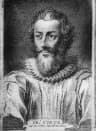
Jean Bodin (1530–1596) was France best known for French jurist, witchcraft theorist and political philosopher (1529 or 1530–1596).
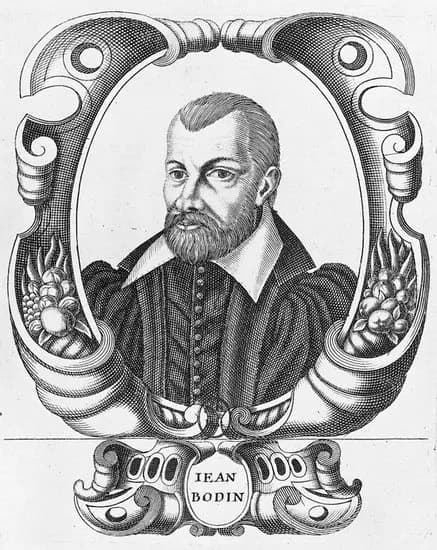
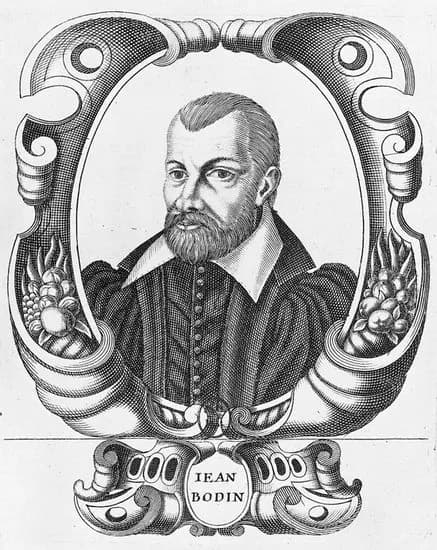
Jean Bodin (January 1, 1530 – June 7, 1596) was a French jurist, political philosopher, and witchcraft theorist from Angers, France. He developed the theory of sovereignty, advocating for a strong national monarchy to counter religious conflict. His ideas significantly influenced modern political thought and the concept of the state.
Poglavje
Življenjska poglavja
Poglavje 1 · 1530· Poglavje 1 od 6
Early Life and Origins
Jean Bodin began his life on January 1, 1530, in Angers, a significant city within the historical region of Anjou, France. This birthplace rooted him deeply in the rich cultural and intellectual heritage of the French kingdom. While specific details concerning his immediate family and early childhood remain largely unrecorded, his early life fostered the rigorous intellectual curiosity that would define his career.
He matured in a France grappling with the profound and often violent aftermath of the Protestant Reformation. This period was characterized by widespread religious conflict and civil unrest, which presented substantial challenges to established political structures. The social and political turbulence of his youth undeniably informed his later philosophical inquiries into the essential components of order and state authority.
Poglavje 2· Poglavje 2 od 6
Career Beginnings
Bodin established his academic credentials early in his life, embarking on a distinguished career as a professor of law at the University of Toulouse. This esteemed position allowed him to delve deeply into the intricacies of jurisprudence and legal theory. His role as an educator shaped his abilities to articulate complex concepts with clarity and precision, benefiting countless students.
His expertise in legal matters quickly garnered recognition beyond academia, leading him to serve as a respected jurist-consultant. In this capacity, he provided expert advice on various legal issues, bridging the gap between theoretical law and its practical application. These early experiences were foundational, providing him with a unique perspective on the mechanics of justice and governance within society.
Subsequently, Jean Bodin ascended to a prominent position as a member of the Parlement of Paris, a high court of justice in the French kingdom. This significant role placed him directly at the heart of French political and legal administration, offering firsthand experience with the levers of state power. His involvement with the Parlement exposed him to the practical realities of governing and legislating, profoundly influencing his theoretical development concerning sovereignty and the state.
Poglavje 3· Poglavje 3 od 6
Major Achievements and Career Highlights
A central and enduring achievement of Jean Bodin's extensive career was the articulation of his comprehensive theory of sovereignty. This revolutionary concept posited that the state held ultimate and indivisible power over its citizens and subjects, independent of external influence. He meticulously defined the attributes of this supreme power, establishing a framework that remains relevant in political science today.
He specifically advocated for the strong central control of a national monarchy, believing it offered an essential antidote to the widespread factional strife plaguing France during his lifetime. Bodin argued that a unified sovereign power was indispensable for maintaining peace, enforcing laws, and ensuring the stability of the realm. His ideas provided a compelling justification for robust state authority in an era of fragmentation.
Though outwardly a nominal Catholic throughout his life, Bodin held distinct and critical views on papal authority over governments. He asserted the supremacy of secular rule in temporal matters, advocating for the independence of the state from ecclesiastical control. This stance was particularly significant in an age where the relationship between church and state was a constant source of tension and conflict across Europe.
Beyond his political philosophy, Bodin's intellectual reach extended notably to the study of witchcraft and demonology. He became a prominent witchcraft theorist, immersing himself in the study of supernatural beliefs and practices prevalent in the 16th century. His detailed investigations into these phenomena underscore the breadth of his scholarly interests and his engagement with all aspects of his society's worldview.
Poglavje 4 · 1576· Poglavje 4 od 6
Notable Works or Contributions
Among Jean Bodin's most significant and enduring contributions are his numerous written works, which collectively encapsulate his wide-ranging intellectual pursuits and pioneering ideas. His magnum opus, "Les six livres de la Republique" (often translated as "The Six Books of the Commonwealth"), published in 1576, stands as a foundational text in Western political philosophy. This comprehensive treatise systematically explored the nature of the state, the essential attributes of sovereignty, and the optimal forms of government, laying groundwork for modern political thought.
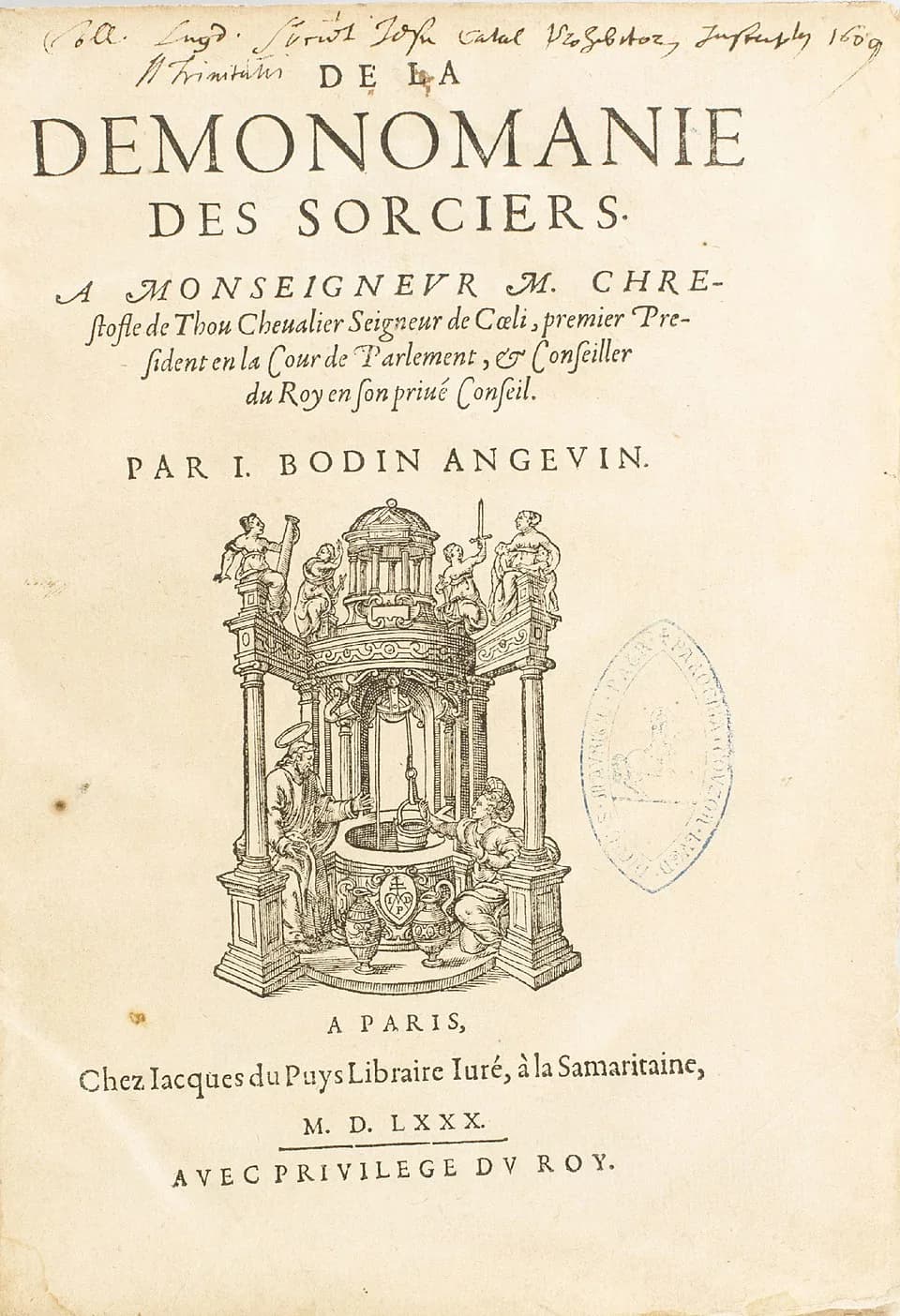
He also delved into the complex and often dark topic of witchcraft with "Demonomania de gli stregoni," known in Latin as "Io. Bodini Andegavensis De magorvm daemonomania," published in 1580. This detailed examination of demonology and sorcery reflected the era's profound beliefs in the supernatural and Bodin's analytical approach to even the most arcane subjects. The work served as a significant contribution to the then-burgeoning field of demonology, influencing contemporary legal and theological debates.
Bodin's intellectual rigor was also evident in his methodological writings, such as "I. Bodini advocati Methodvs, ad facilem historiarvm cognitionem" and "Io. Bodini Methodvs ad facilem historiarum cognitionem." These texts laid out his systematic approach to historical inquiry, emphasizing the importance of critical analysis and comprehensive understanding in studying the past. Such works cemented his reputation not just as a philosopher, but also as a meticulous historian and scholar.
His bibliography further includes titles like "Los seis libros de la Republica de Ivan Bodino," demonstrating the translation and wide reception of his political ideas across Europe. The inclusion of "Un économiste libéral au xvie siècle" points to his contributions in economic thought, showcasing his insights into nascent liberal economic principles. Moreover, "Apologie de René Herpin [pseud.] povr la répvbliqve de I. Bodin" highlights his engagement with critiques of his political theories, potentially under a pseudonym, reflecting his active participation in contemporary intellectual debates.
Poglavje 5· Poglavje 5 od 6
Later Years
As his career matured and progressed, Jean Bodin continued to contribute vigorously to both intellectual discourse and public life. His profound ideas, particularly those concerning the conceptualization of the state and the nature of governance, remained central to ongoing debates among European scholars and influential rulers. He consistently refined and defended his theories, ensuring their relevance in a changing political landscape.
He spent his final years residing in Laon, France, a city where he had significant connections. It was there that this influential figure passed away on June 7, 1596, marking the end of a life dedicated to intellectual pursuit and the betterment of society. Even in these later stages, Bodin's intellectual energy persisted, ensuring that his legacy would be firmly established for future generations to study and build upon.
Poglavje 6· Poglavje 6 od 6
Legacy and Impact
Jean Bodin's legacy is primarily defined by his profound and lasting impact on Western political thought, particularly through his sophisticated and original theory of sovereignty. His concept provided an essential theoretical framework for understanding and legitimizing national unity and stability during a profoundly volatile historical period. Bodin's articulation of supreme, indivisible state power became a cornerstone of modern political philosophy.
He played a crucial role in establishing the very concept of the state as a distinct political entity possessing ultimate authority, separate and often superior to religious institutions. This separation was a significant intellectual development in an era where church and state powers were frequently intertwined and contested. His writings offered a clear rationale for secular governance in an increasingly complex world.
Beyond his political contributions, Bodin's comprehensive scholarship across law, economics, and history positioned him as a truly erudite figure of the Renaissance. His analytical rigor and diverse interests underscore his status as a scholar deeply invested in understanding the entirety of human society. Bodin's incisive analysis of religious conflict and his steadfast call for state authority as a unifying force continue to resonate, centuries after his death, cementing his place as an intellectual giant whose ideas continue to be studied and debated.
Življenje v trenutkih
Trenutki, ki so oblikovali življenje
Pogosta vprašanja
Pogosto vprašano
Kdaj je umrl(a) Jean Bodin?
Jean Bodin je umrl(a) 7. junij 1596 v Laon, France v starosti 66 let.
Kje je bil(a) rojen(a) Jean Bodin?
Jean Bodin je bil(a) rojen(a) v Angers, France dne 1. januar 1530.
Po čem je Jean Bodin najbolj znan(a)?
Jean Bodin je najbolj znan(a) po French jurist, witchcraft theorist and political philosopher (1529 or 1530–1596).
Koliko je bil(a) Jean Bodin star(a) ob smrti?
Jean Bodin je bil(a) ob smrti star(a) 66 let.
Katere narodnosti je bil(a) Jean Bodin?
Jean Bodin je bil(a) iz France.
Časovnica
Življenje na hitro
Galerija fotografij
Življenje v slikah
Kliknite katero koli polaroidno fotografijo za povečavo · 35 fotografij
Koda QR
Deli to biografijo
Natisni in deli
Skenirajte za obisk te biografske strani. Natisnite za dogodke, razstave ali izobraževalna gradiva.