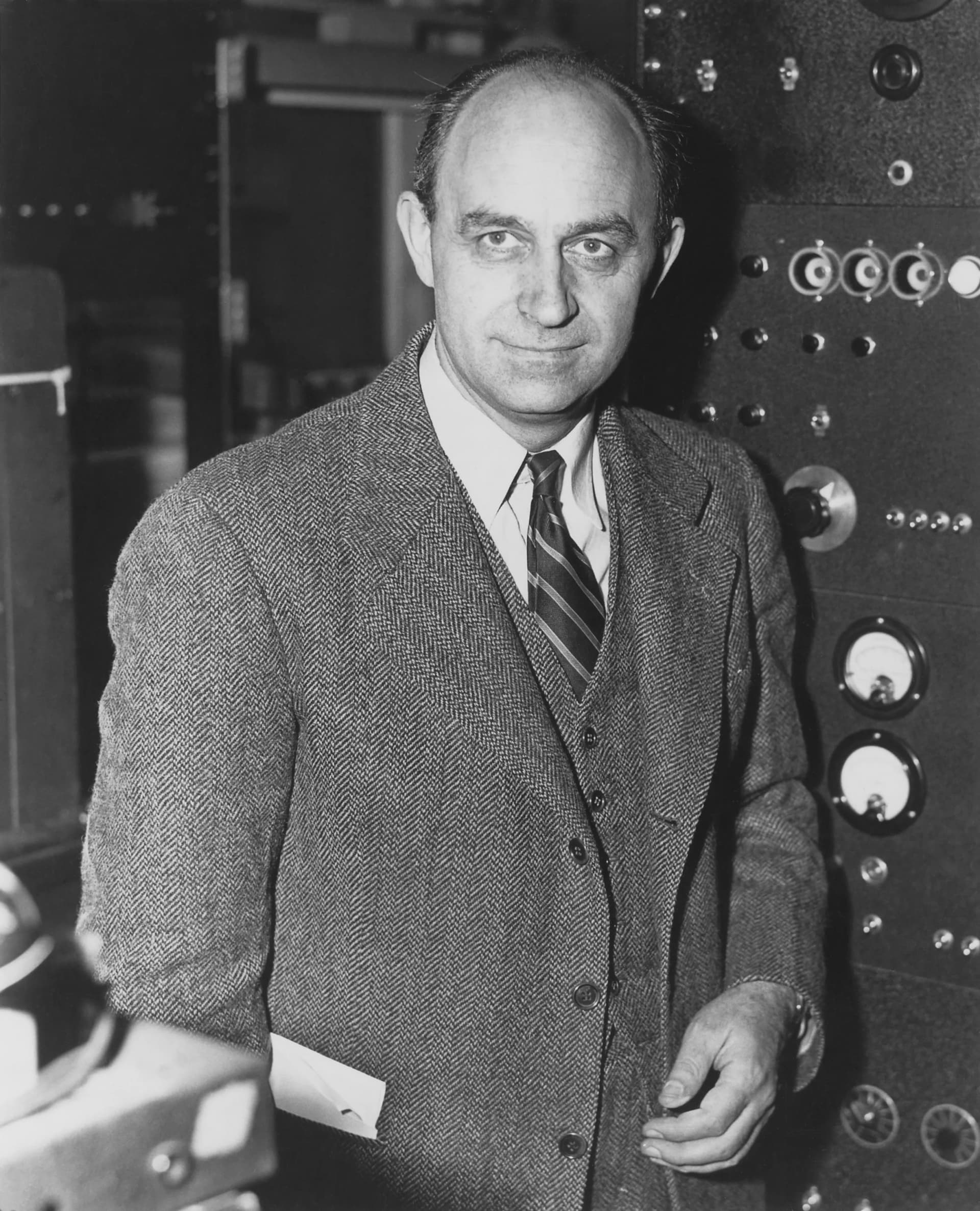
Gimęs
September 29, 1901
Rome, Italy
Miręs
November 28, 1954
Chicago, United States
Žinomas dėl
Italian–American physicist
Enrico Fermi (1901–1954) was Italy best known for Italian–American physicist.
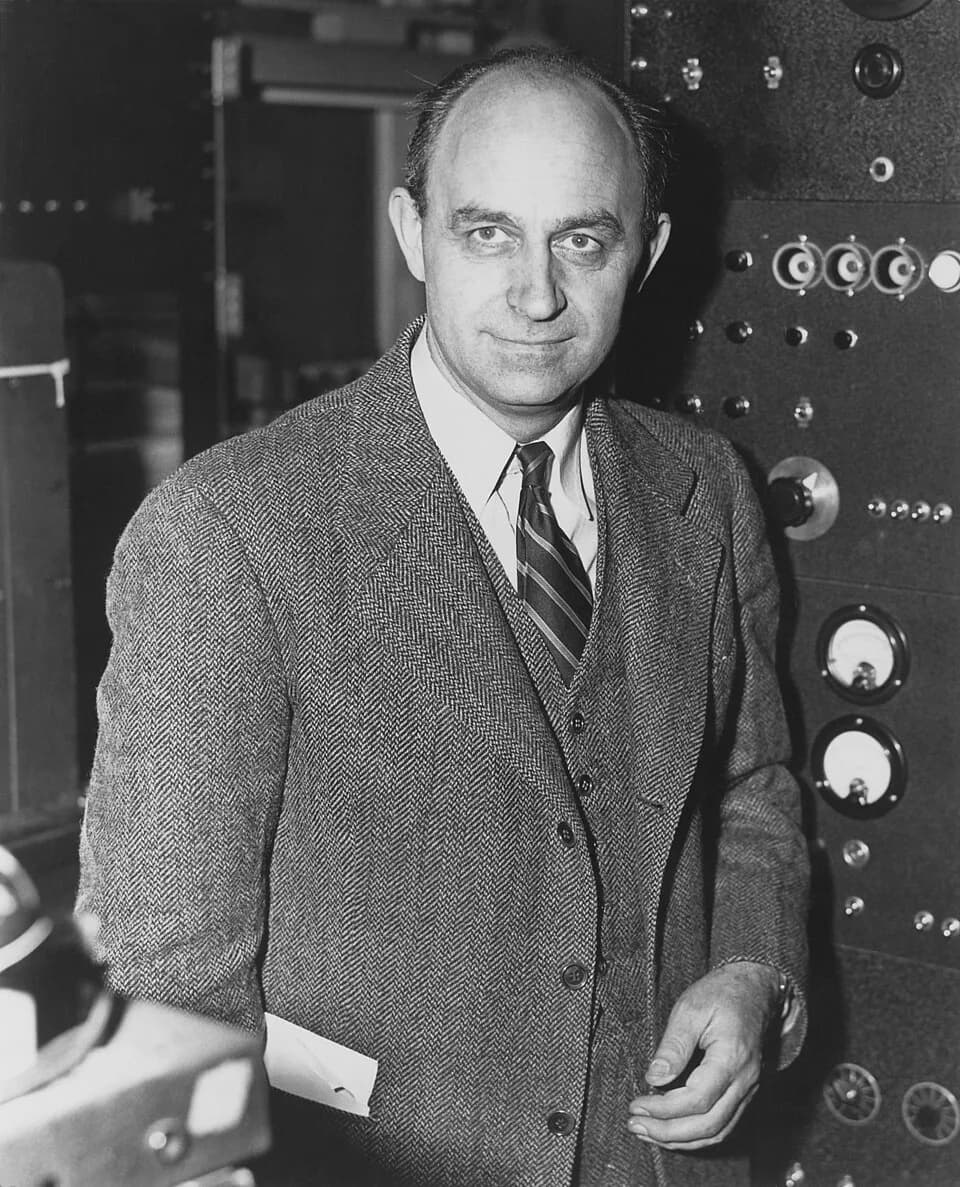
Enrico Fermi (September 29, 1901 – November 28, 1954) was an Italian-American physicist from Rome, Italy. He created the world's first nuclear reactor, the Chicago Pile-1, and won the 1938 Nobel Prize in Physics for his neutron irradiation work. His legacy marks him as the architect of the nuclear age.
Skyrius
Gyvenimo skyriai
Skyrius 1 · 1901· Skyrius 1 iš 6
Early Life and Origins
Born in Rome, Italy, on September 29, 1901, Enrico Fermi's intellectual journey began in his native country. From an early age, he displayed an exceptional aptitude for mathematics and physics, signaling the extraordinary scientific mind he possessed. His formative years in Italy provided a rich environment for his intellectual growth, culminating in a rigorous education that prepared him for a lifetime of pioneering discoveries. This early commitment to scientific inquiry and relentless study cultivated the precise and rigorous intellectual approach that would ultimately define his illustrious professional life.
Skyrius 2· Skyrius 2 iš 6
Career Beginnings
Fermi embarked on his professional career as a physicist and university teacher, swiftly establishing himself as a formidable and innovative intellectual force in the academic world. His early work involved deep theoretical investigations, particularly advancing the understanding of quantum mechanics and statistical mechanics, where he developed crucial models. Concurrently, he cultivated an exceptional practical command of experimental techniques, demonstrating a truly rare and invaluable talent for excelling with equal prowess in both theoretical and experimental physics. This unique and powerful dual mastery of scientific method became a distinguishing hallmark of his entire distinguished career, allowing him to bridge conceptual ideas with empirical verification seamlessly.
Skyrius 3 · 1938· Skyrius 3 iš 6
Major Achievements and Career Highlights
A significant and crowning achievement in Enrico Fermi's career was the profound recognition he received through the 1938 Nobel Prize in Physics. The Swedish Academy specifically honored him "for his demonstrations of the existence of new radioactive elements produced by neutron irradiation, and for his related discovery of nuclear reactions brought about by slow neutrons." This pioneering work and meticulously executed research revealed entirely new possibilities for understanding and skillfully manipulating atomic nuclei, fundamentally altering the scientific landscape of the time. His pioneering work provided a critical theoretical and experimental foundation for the eventual harnessing of nuclear energy, courageously opening doors to previously unimagined scientific and technological advancements that would define an era.
Another truly monumental accomplishment that etched Fermi’s name into history was his astute leadership in creating the world's first artificial nuclear reactor, which he famously dubbed the Chicago Pile-1. This historic event, achieved through immense dedication with his brilliant colleagues on December 2, 1942, demonstrated for the first time the practical feasibility of achieving a self-sustaining nuclear chain reaction. The unqualified success of Chicago Pile-1 was a profound watershed moment, unequivocally marking the definitive beginning of the nuclear age and proving that controlled nuclear power was no longer merely a theoretical concept. It powerfully underscored Fermi's exceptional ability to translate the most complex theoretical physics into practical, world-altering technology that would resonate for generations.
Fermi also played an absolutely crucial and highly sensitive role as a key member of the Manhattan Project during World War II, a top-secret endeavor of immense global significance. His unparalleled expertise in both theoretical and experimental nuclear physics was considered indispensable to the project's ambitious and urgent goal of developing the atomic bomb. His scientific leadership, deep insights, and practical problem-solving capabilities were central to the project's ultimate success. This period solidified his stature and earned him the stark but historically accurate title of "architect of the atomic bomb," highlighting the profound and often complex ethical implications of his unparalleled scientific discoveries and their real-world applications.
Skyrius 4· Skyrius 4 iš 6
Notable Works or Contributions
Beyond his Nobel Prize-winning research and direct involvement in the Manhattan Project, Fermi made truly significant and lasting contributions across several fundamental branches of physics. His pioneering work profoundly advanced the nascent fields of statistical mechanics, quantum theory, and both nuclear and particle physics, establishing many of the core tenets still used today. He developed foundational principles and theories, such as Fermi-Dirac statistics, which continue to inform scientific understanding in these intricate areas, showcasing his immense intellectual breadth and foresight. His remarkable ability to connect diverse physical phenomena allowed him to synthesize complex ideas, consistently pushing the boundaries of existing scientific knowledge.
In addition to his towering theoretical insights, Enrico Fermi was a prolific and pragmatic inventor, securing several critical patents directly related to the revolutionary use of nuclear power. These patents, born from his innovative experimental designs and deep practical understanding of nuclear processes, were later acquired by the U.S. government due to their national strategic importance. His inventive spirit and practical genius ensured that his groundbreaking discoveries had tangible, real-world applications, further cementing his place as an unparalleled pioneer in the practical application of nuclear science. Specifically, his profound discovery of nuclear reactions brought about by slow neutrons was particularly impactful, demonstrating a novel and efficient way to interact with atomic nuclei and initiate chain reactions.
Skyrius 5· Skyrius 5 iš 6
Later Years
After his epoch-making discoveries and his crucial involvement with the Manhattan Project, Enrico Fermi continued his vital scientific work, now firmly established as an Italian-American physicist. Having relocated from his birth country, Italy, to the United States, he embraced his new environment, continuing his scientific endeavors with unwavering dedication. His later years were characterized by sustained intellectual productivity, engaging with the most pressing scientific questions and challenges of his era, often at the University of Chicago. He remained a central, guiding figure in the international scientific community, influencing peers and students alike through his profound intellect and meticulous approach.
Enrico Fermi passed away in Chicago, United States, on November 28, 1954, at the relatively young age of 53. His passing marked the end of an extraordinarily prolific career, but his profound influence on science, technology, and global affairs continued unabated. His foundational contributions ensured that the nascent fields he helped establish and nurture would flourish for many decades to come, driven by the fundamental principles he first courageously elucidated and rigorously demonstrated. His relatively early death was a great loss to the scientific world, yet his legacy was already secured.
Skyrius 6· Skyrius 6 iš 6
Legacy and Impact
Enrico Fermi's legacy is truly immense and enduring, profoundly shaping modern physics and technological advancement. He is rightly and universally called the "architect of the nuclear age" for his absolutely central and indispensable role in ushering in an entirely new era defined by both nuclear power and nuclear weaponry. His truly rare and invaluable ability to excel with such mastery in both theoretical and experimental physics allowed him to uniquely bridge the critical gap between abstract scientific concepts and their tangible, practical applications. This distinctive and powerful skill set enabled him to not only conceive brilliant new theories but also to rigorously test and demonstrate them empirically, often with his own hands.
His pioneering work on neutron irradiation, the essential role of slow neutrons, and the historic creation of the first controlled nuclear reactor fundamentally transformed humanity's understanding of energy, matter, and the very fabric of the universe. The essential patents he filed and the robust scientific principles he meticulously established continue to serve as cornerstones of all nuclear technology and research worldwide. Fermi's pervasive influence extends far beyond the specific projects and discoveries he led, continuing to inspire countless generations of physicists to explore the deepest mysteries of the universe with the same rigor and curiosity. His extraordinary life and unparalleled career remain a powerful demonstration of intellectual brilliance, unwavering scientific rigor, and the immense, world-changing effect one dedicated individual can exert on the entire world.
Gyvenimas akimirkomis
Akimirkos, formavusios gyvenimą
DUK
Dažnai užduodami
Kada mirė Enrico Fermi?
Enrico Fermi mirė 1954 m. lapkričio 28 d. Chicago, United States sulaukęs 53 metų.
Kur gimė Enrico Fermi?
Enrico Fermi gimė Rome, Italy 1901 m. rugsėjo 29 d..
Kuo labiausiai žinomas(a) Enrico Fermi?
Enrico Fermi labiausiai žinomas(a) dėl Italian–American physicist.
Kiek metų buvo Enrico Fermi mirties metu?
Enrico Fermi mirties metu buvo 53 metų.
Kokios tautybės buvo Enrico Fermi?
Enrico Fermi buvo kilęs iš Italy.
Laiko juosta
Gyvenimas iš pirmo žvilgsnio
Nuotraukų galerija
Gyvenimas paveiksluose
Spustelėkite bet kurią poliaroidą, kad išplėstumėte · 44 nuotraukų
QR kodas
Dalintis šia biografija
Spausdinti ir dalintis
Nuskaitykite, kad apsilankytumėte šiame biografijos puslapyje. Spausdinkite renginiams, parodoms ar mokomajai medžiagai.