출생
April 30, 1777
Brunswick, Germany
별세
February 23, 1855
Göttingen, Germany
알려진 업적
German mathematician and physicist
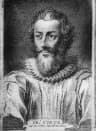
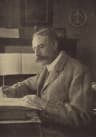
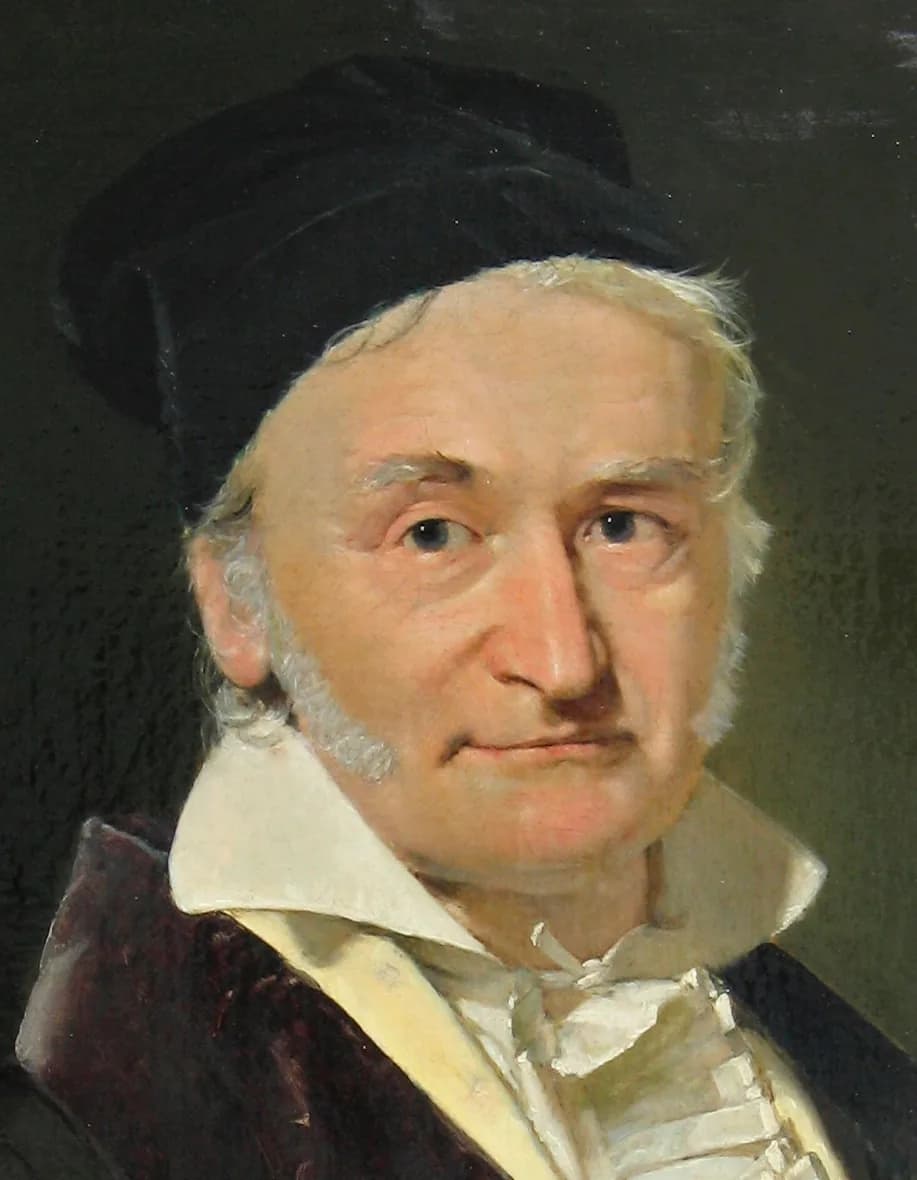
Carl Friedrich Gauss (1777–1855) was Germany best known for German mathematician and physicist.
Carl Friedrich Gauss (April 30, 1777 – February 23, 1855) was a German mathematician and physicist from Brunswick, Germany. He made significant contributions to number theory, algebra, geometry, and astronomy, serving as director of the Göttingen Observatory. His work laid foundational principles across many scientific disciplines.
챕터
삶의 챕터
챕터 1 · 1777· 7장 중 1장
Early Life and Origins
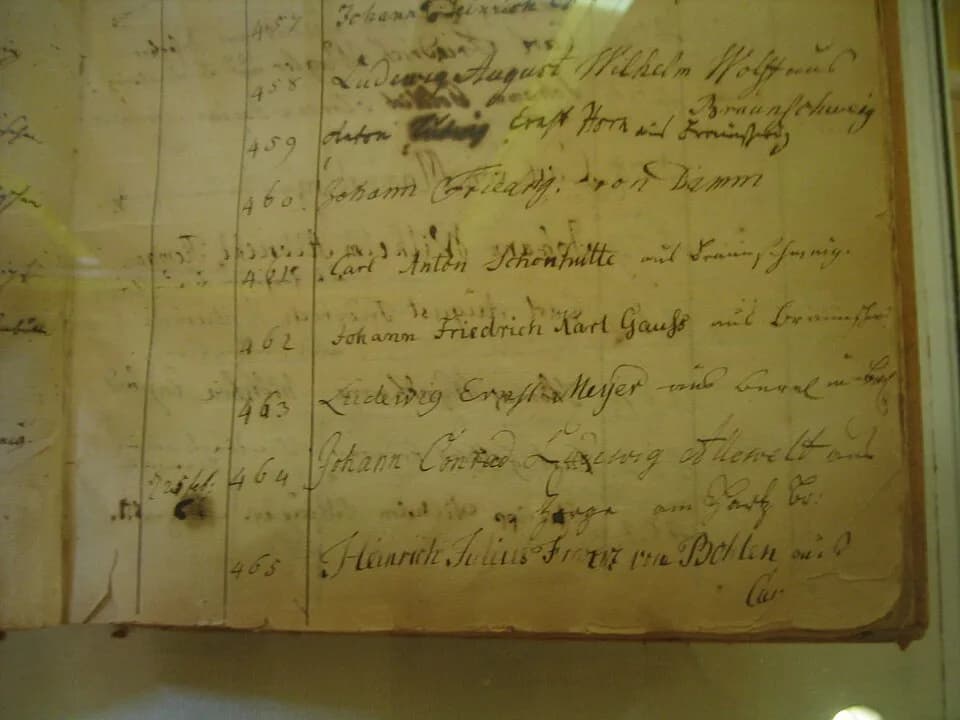
Carl Friedrich Gauss was born on April 30, 1777, in Brunswick, Germany. His early life in Brunswick laid the foundation for a career dedicated to rigorous intellectual pursuit. Though specific details about his family and upbringing are not widely documented, his birthplace marked the beginning of a life that would profoundly impact the scientific community.
챕터 2 · 1807· 7장 중 2장
Career Beginnings
Gauss began his significant professional career as the director of the Göttingen Observatory in Germany. This appointment took place in 1807, alongside his role as a professor of astronomy at the University of Göttingen. He held both prestigious positions continuously until his passing in 1855, marking a period of nearly five decades of dedicated service and scientific leadership within the institution.
챕터 3· 7장 중 3장
Major Achievements and Career Highlights
Throughout his distinguished career, Carl Friedrich Gauss contributed significantly to a wide array of fields, earning him recognition as a preeminent figure in both mathematics and physics. His expertise extended to being an astronomer, surveyor, university teacher, statistician, science writer, geophysicist, and geodesist. These diverse roles highlight the breadth of his intellectual curiosity and his capacity for original thought across various scientific domains.
Among his most significant achievements were his far-reaching mathematical contributions, which encompassed number theory, algebra, analysis, geometry, statistics, and probability. Gauss developed fundamental concepts and theories within each of these branches, providing frameworks that future generations of mathematicians would build upon. His work also involved practical applications, particularly in his capacity as a geodesist, where he applied mathematical principles to the study of the Earth's shape and gravitational field.
As the director of the Göttingen Observatory, Gauss oversaw important astronomical observations and research. His tenure from 1807 until 1855 allowed him to guide scientific endeavors and mentor students, further cementing Göttingen's reputation as a center of scientific excellence. His combined roles as an astronomer and a physicist meant that his theoretical insights often found practical expression in real-world measurements and observations.
챕터 4· 7장 중 4장
Personal Life
While Carl Friedrich Gauss's professional life and scientific contributions are extensively documented, the provided information does not detail aspects of his personal life, such as family, relationships, or personal interests outside of his professional pursuits. His dedication to his scientific work remains the primary focus of historical records.
챕터 5 · 1801· 7장 중 5장
Notable Works or Contributions
Carl Friedrich Gauss produced numerous influential works that established new directions in mathematics and science. One of his most foundational texts, "Disqvisitiones arithmeticae," published in 1801, systematically organized number theory and introduced key concepts that remain central to the field. This work alone cemented his reputation as a master of arithmetic and laid much of the groundwork for modern number theory.
His contributions to algebra and geometry were equally significant, exemplified by "Die vier Gauss'schen Beweise für die Zerlegnung ganzer algebraischer Functionen in reelle Factoren ersten oder zweiten Grades," which spanned from 1799 to 1849. This series of proofs addressed a critical problem in the fundamental theorem of algebra. Additionally, his "Allgemeine Flächentheorie" (General Theory of Surfaces) profoundly influenced differential geometry, demonstrating his deep understanding of curved surfaces and their properties.
Gauss also engaged with practical instrumentation and theoretical physics, evident in works such as "Ferraris' dioptric instruments" and "Principia generalia theoriae figvrae flvidorum in statv aeqvilibrii." He explored celestial mechanics in "Disquisitio de elementis ellipticis palladis" and pioneered methods for approximation in "Neue methode zur näherungsweisen auffindung von integralwerten." His "Resultate [aus den beobachtungen des Magnetischen vereins" further showcased his work in geophysics and magnetism, underscoring his wide-ranging scientific curiosity.
챕터 6 · 1855· 7장 중 6장
Later Years
Carl Friedrich Gauss continued his active scientific career well into his later years. He maintained his positions as director of the Göttingen Observatory and professor of astronomy until his death on February 23, 1855. His final decades were characterized by sustained intellectual productivity and leadership in the scientific community, further solidifying his enduring influence in Göttingen and beyond.
챕터 7· 7장 중 7장
Legacy and Impact
The legacy of Carl Friedrich Gauss endures through the fundamental principles and methods he introduced across numerous scientific fields. His detailed work in number theory, algebra, analysis, and geometry continues to be foundational for modern mathematical research and education. Students and scholars worldwide still engage with concepts he originated, illustrating the timeless nature of his insights.
Beyond pure mathematics, Gauss's impact as an astronomer, geodesist, physicist, and statistician is similarly profound. His methods for statistical analysis, astronomical calculation, and geodetic surveying provided tools that were essential for the advancement of these sciences during his lifetime and continue to be relevant today. Carl Friedrich Gauss remains a figure whose broad contributions shaped the trajectory of scientific inquiry for centuries to come.
순간 속의 삶
한 삶을 빚어낸 순간들
FAQ
자주 묻는 질문
Carl Friedrich Gauss은(는) 언제 사망했습니까?
Carl Friedrich Gauss은(는) 1855년 2월 23일 Göttingen, Germany에서 사망했습니다 (향년 77세).
Carl Friedrich Gauss은(는) 어디에서 태어났습니까?
Carl Friedrich Gauss은(는) Brunswick, Germany에서 1777년 4월 30일에 태어났습니다.
Carl Friedrich Gauss은(는) 무엇으로 가장 잘 알려져 있습니까?
Carl Friedrich Gauss은(는) German mathematician and physicist(으)로 가장 잘 알려져 있습니다.
Carl Friedrich Gauss은(는) 사망 당시 몇 살이었습니까?
Carl Friedrich Gauss은(는) 사망 당시 77세였습니다.
Carl Friedrich Gauss의 국적은 무엇이었습니까?
Carl Friedrich Gauss은(는) Germany 출신이었습니다.
연표
한눈에 보는 삶
사진 갤러리
사진으로 보는 삶
폴라로이드를 클릭하여 확대 · 사진 24장
QR 코드
이 전기 공유
인쇄 및 공유
스캔하여 이 전기 페이지를 방문하세요. 행사, 전시회, 교육 자료에 인쇄해 사용하실 수 있습니다.