Jaioa
February 14, 1869
Glencorse, United Kingdom
Hila
November 15, 1959
Carlops, United Kingdom
Ezaugarriak
Scottish physicist and meteorologist
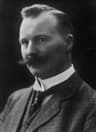
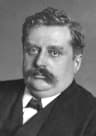
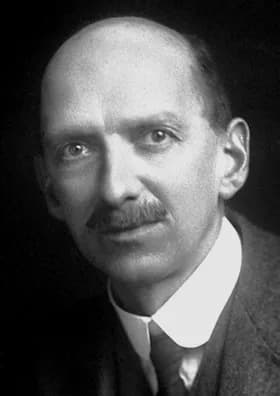
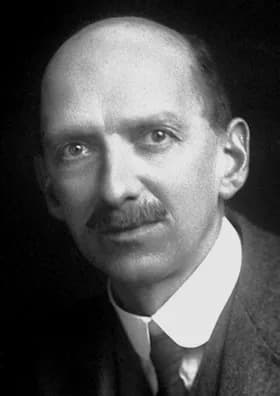
Charles Thomson Rees Wilson (1869-1959) was a Scottish physicist and meteorologist who invented the cloud chamber, making visible the paths of electrically charged particles. He shared the 1927 Nobel Prize in Physics for this revolutionary contribution to particle physics research.
0 kapitulua
Bizitzako kapituluak
1 kapitulua · 1869· 1. kapitulua 6tik
Early Life and Origins
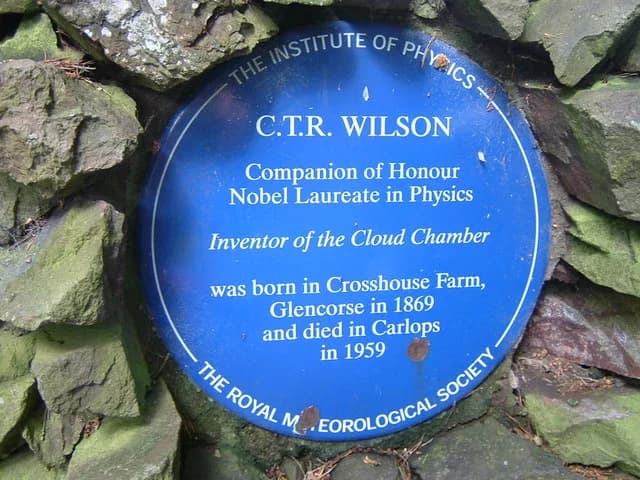
Charles Thomson Rees Wilson was born on February 14, 1869, in Glencorse, a small village in the Scottish countryside south of Edinburgh. Growing up in this rural setting likely fostered his early fascination with natural phenomena, particularly the weather patterns and cloud formations that would later inspire his most famous invention. The young Wilson showed an early aptitude for scientific observation and inquiry that would define his entire career.
2 kapitulua· 2. kapitulua 6tik
Career Beginnings
Wilson began his scientific career as both a physicist and meteorologist, drawn to understanding the fundamental processes that govern our atmosphere. His dual expertise in these fields positioned him uniquely to tackle complex problems that required both theoretical knowledge and practical observation skills. As a university teacher and scholar, he combined his research pursuits with educating the next generation of scientists.
3 kapitulua · 1927· 3. kapitulua 6tik
Major Achievements and Career Highlights
Wilson's crowning achievement came with his invention of the cloud chamber, a revolutionary device that made visible the previously invisible paths of electrically charged particles. This breakthrough earned him the 1927 Nobel Prize in Physics, which he shared with Arthur Compton. The Nobel Committee recognized his work "for his method of making the paths of electrically charged particles visible by condensation of vapour."
His research extended far beyond particle physics into atmospheric science, where he made significant contributions to understanding lightning and thunderstorm electricity. Wilson's work bridged the gap between laboratory physics and real-world atmospheric phenomena, demonstrating how fundamental scientific principles operate in nature's most dramatic displays.
4 kapitulua · 1916· 4. kapitulua 6tik
Notable Works and Contributions
Wilson's most influential publication, "On some determinations of the sign and magnitude of electric discharges in lightning flashes" (1916), garnered 129 citations and established him as a leading authority on atmospheric electricity. His 1912 paper "On an Expansion Apparatus for Making Visible the Tracks of Ionising Particles in Gases and Some Results Obtained by Its Use" detailed his cloud chamber invention and its early applications, receiving 86 citations from fellow researchers.
Later in his career, Wilson continued his atmospheric research with "A theory of thundercloud electricity" (1956), which received 120 citations and demonstrated his sustained contributions to meteorological science well into his later years. His work on X-rays and beta rays using his cloud chamber method further established the technique's versatility across different areas of physics research.
Throughout his career, Wilson published 20 significant papers and achieved an h-index of 15, reflecting the lasting impact of his research on multiple scientific disciplines. His investigations into condensation nuclei produced by various forms of radiation helped establish fundamental understanding of particle-matter interactions.
5 kapitulua · 1956· 5. kapitulua 6tik
Later Years
Wilson continued his research and teaching well into his later years, maintaining his passion for both atmospheric science and particle physics. His 1956 publication on thundercloud electricity showed that even in his eighties, he remained actively engaged with cutting-edge scientific questions. He spent his final years in Carlops, Scotland, not far from where he was born, maintaining his connection to the Scottish countryside that had shaped his early fascination with natural phenomena.
6 kapitulua· 6. kapitulua 6tik
Legacy and Impact
The cloud chamber became an essential tool in early particle physics research, enabling scientists to observe and photograph particle tracks for the first time. This visualization capability was crucial for validating theoretical predictions about atomic and subatomic behavior. Wilson's invention paved the way for numerous discoveries in particle physics throughout the 20th century.
His contributions to atmospheric science, particularly his work on lightning and thunderstorm electricity, laid important groundwork for modern meteorological understanding. The combination of his particle physics innovations with his atmospheric research created a unique scientific legacy that influenced both laboratory physics and field meteorology. Wilson passed away on November 15, 1959, in Carlops, United Kingdom, leaving behind a scientific legacy that continues to influence research in both particle physics and atmospheric science.
Bizitza uneetan
Bizitza moldatu zuten uneak
Ohiko galderak
Maiz egindako galderak
Noiz hil zen Charles Thomson Rees Wilson?
Charles Thomson Rees Wilson 1959(e)ko azaroaren 15(a) hil zen Carlops, United Kingdom-n, 90 urte zituela.
Non jaio zen Charles Thomson Rees Wilson?
Charles Thomson Rees Wilson Glencorse, United Kingdom-n jaio zen 1869(e)ko otsailaren 14(a).
Zertarako da ezagunena Charles Thomson Rees Wilson?
Charles Thomson Rees Wilson ezagunena da Scottish physicist and meteorologist-rengatik.
Zenbat urte zituen Charles Thomson Rees Wilson-k hil zenean?
Charles Thomson Rees Wilson-k 90 urte zituen hil zenean.
Zer nazionalitatekoa zen Charles Thomson Rees Wilson?
Charles Thomson Rees Wilson United Kingdom-koa zen.
Denbora-lerroa
Bizitza begirada batean
Argazki galeria
Bizitza iruditan
Egin klik edozein polaroidetan handitzeko · 43 argazki
QR kodea
Partekatu Biografia Hau
Inprimatu eta partekatu
Eskaneatu biografia orri hau bisitatzeko. Inprimatu ekitaldi, erakusketa edo hezkuntza materialetarako.