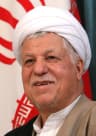
Født
May 12, 1977
Tehran, Iran
Død
July 14, 2017
Stanford, United States
Kendt for
Iranian mathematician
Maryam Mirzakhani (1977–2017) was Iran best known for Iranian mathematician.
Maryam Mirzakhani (May 12, 1977 – July 14, 2017) was an Iranian mathematician. She became the first woman and first Iranian to win the prestigious Fields Medal, recognized for her work on Riemann surfaces and their moduli spaces. Her legacy significantly shaped hyperbolic geometry and topology.
Kapitel
Livskapitler
Kapitel 1 · 1977· Kapitel 1 af 6
Early Life and Origins
Maryam Mirzakhani began her life's journey in Tehran, Iran, on May 12, 1977, a formative environment that nurtured her extraordinary intellect. Her early years were characterized by a deep curiosity and an innate ability to grasp complex ideas, which quickly set her apart. The educational system in Iran provided the rigorous foundation upon which she would build her stellar academic career, encouraging her blossoming talent for complex problem-solving. This early immersion in the world of numbers and proofs was critical, instilling in her the discipline and innovative thinking that would later define her professional contributions, driving her towards a path of profound discovery.
Kapitel 2· Kapitel 2 af 6
Career Beginnings
Mirzakhani embarked on her professional career as a mathematician with a clear vision and an unyielding dedication to research, quickly ascending to prominence within the academic world. Her initial work laid the groundwork for her specialization in fields like topology, which examines the properties of space that are preserved under continuous deformations, and geometry, the study of shapes, sizes, relative positions of figures, and the properties of space itself. She brought a distinctive analytical power and an innovative problem-solving methodology to these venerable disciplines, promising a future of significant breakthroughs.
Her tenure as a professor of mathematics at Stanford University was a key period where she thrived as both a researcher and an educator. At Stanford, she explored advanced research topics, contributing actively to the institution’s renowned intellectual community, and significantly influencing her peers and students. Her early career demonstrated her relentless pursuit of knowledge, her eagerness to challenge established mathematical boundaries, and her innate ability to articulate highly complex theories with clarity and precision, marking her as a rapidly rising star in her chosen profession.
Kapitel 3 · 2014· Kapitel 3 af 6
Major Achievements and Career Highlights
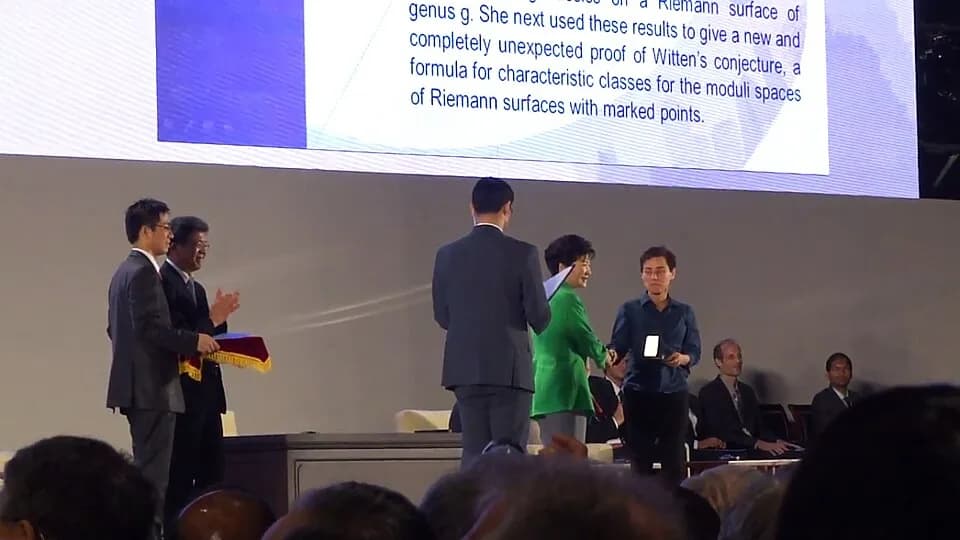
A defining moment in Maryam Mirzakhani's illustrious career came on August 13, 2014, when she was awarded the Fields Medal, universally acknowledged as the most prestigious accolade in mathematics. This honor was not merely a recognition of individual genius but a landmark event for the entire global scientific community. She made history by becoming the first woman ever to receive the coveted prize, shattering a long-standing barrier and inspiring generations of aspiring female mathematicians worldwide. Furthermore, her achievement marked her as the first Iranian to earn this esteemed recognition, bringing immense national pride and celebrating a global triumph for Iranian scholarship.
The committee for the Fields Medal specifically lauded her work in "the dynamics and geometry of Riemann surfaces and their moduli spaces," highlighting the deep originality and depth of her contributions. Riemann surfaces are fundamental objects in complex analysis and algebraic geometry, while moduli spaces are geometric spaces whose points represent geometric objects of a certain kind. Mirzakhani's research unveiled new insights into how these complex surfaces behave and interact, exploring their transformations and intrinsic properties. Her work provided a deeper understanding of these abstract concepts, which have wide-ranging implications for various mathematical subfields, revealing connections that were previously unknown.
Throughout her career, Maryam Mirzakhani was justly celebrated as a leading force in the intricate fields of hyperbolic geometry, topology, and dynamics. Hyperbolic geometry, a non-Euclidean geometry, describes spaces with constant negative curvature, while topology focuses on properties of spaces preserved under continuous deformation, and dynamics studies systems that change over time. Her innovative approaches and deep theoretical advancements significantly re-shaped and enriched understanding in these areas, introducing novel techniques and conceptual frameworks that continue to influence contemporary mathematical research. She consistently pushed the frontiers of knowledge, cementing her status as a central and visionary figure whose contributions provided foundational elements for future mathematical exploration.
Kapitel 4· Kapitel 4 af 6
Notable Works or Contributions
Maryam Mirzakhani’s intellectual legacy is robustly documented through her extensive academic output, which includes an impressive h-index of 19 and a significant total of 37 published papers. These publications collectively represent a monumental body of work that significantly advanced several sophisticated branches of pure mathematics. Each paper exemplifies her rigorous research methodology, her unique aptitude for abstract problem-solving, and her unwavering commitment to extending the boundaries of mathematical comprehension, enriching the collective knowledge of the global mathematical community.
Among her most highly cited contributions is the paper titled "Lengths of closed geodesics on random surfaces of large genus," which saw publication in 2017, the same year of her passing. This deeply influential work has been cited 74 times, underscoring its enduring significance and its far-reaching effects on the study of geometric dynamics. The paper stands as a powerful demonstration of her unparalleled analytical capabilities and her ability to confront and elegantly resolve some of the most complex and abstract problems in modern mathematics, solidifying her reputation as a pioneering theorist.
The depth and breadth of Mirzakhani's foundational insights continued to resonate and gain recognition in the years following her death, with several impactful papers appearing posthumously, further illustrating the lasting power of her theoretical frameworks. For instance, her work titled "Effective counting of simple closed geodesics on hyperbolic surfaces," which was published in 2019, quickly garnered 30 citations, highlighting the continued relevance and deep influence of her meticulously developed research methodologies. Such works clearly demonstrate the timeless nature of her ideas, which persistently inspire new lines of mathematical inquiry and contribute to ongoing advancements in the field.
Mirzakhani’s far-reaching influence also extended into diverse scientific domains, exemplifying her significant versatility and intellectual agility, as showcased in works such as "Circular quantum dots in twisted bilayer graphene" from 2020, which accumulated 14 citations. Additionally, her paper "Edge states in gated bilayer-monolayer graphene ribbons and bilayer domain walls" from 2018 received 6 citations, and "Isolated and hybrid bilayer graphene quantum rings" from 2021 attracted 5 citations. These publications collectively illustrate the wide-ranging implications and practical applications of her sophisticated mathematical frameworks across interdisciplinary fields, demonstrating a rare capacity to forge meaningful connections between seemingly disparate scientific and engineering disciplines.
Kapitel 5 · 2017· Kapitel 5 af 6
Later Years
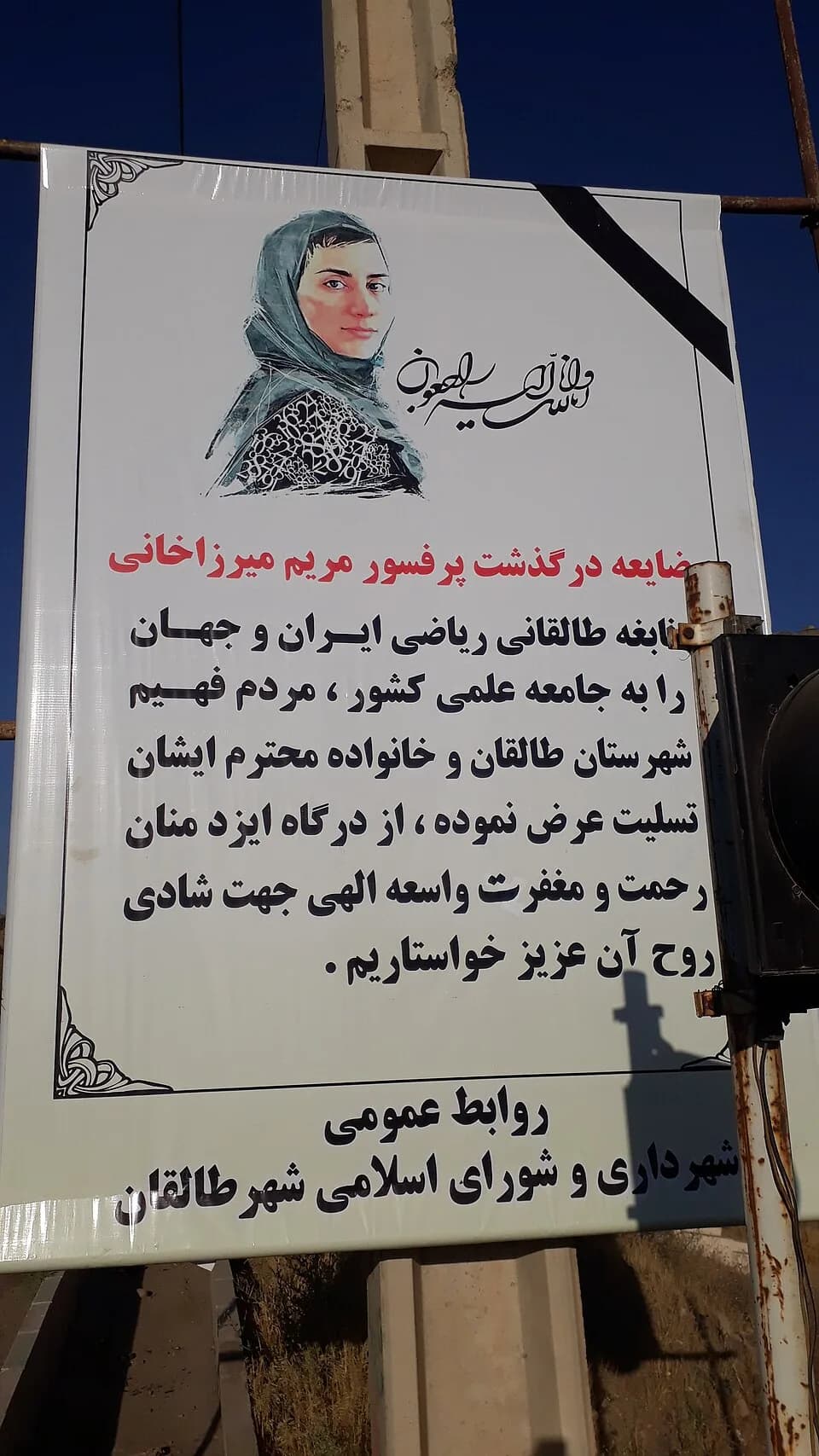
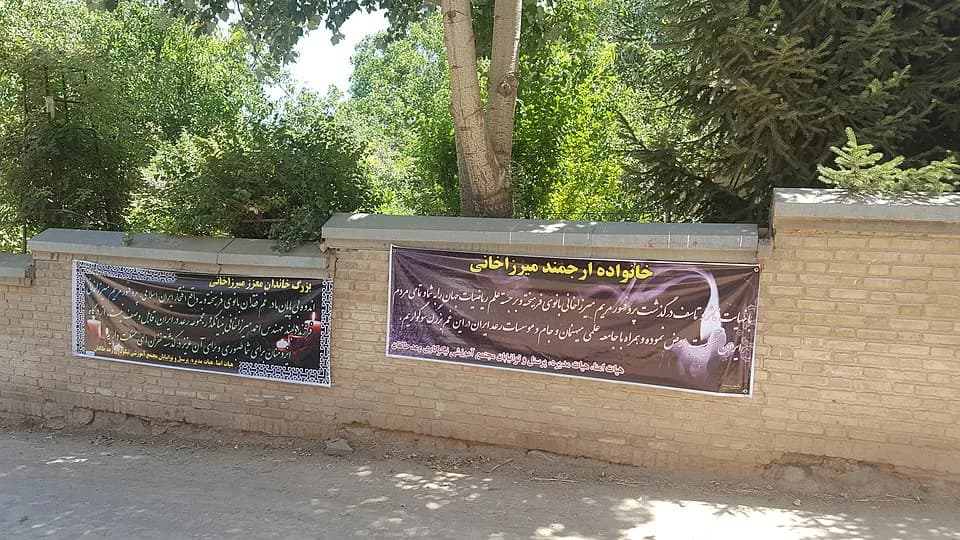
In her later years, Maryam Mirzakhani remained deeply committed to her pioneering research and dedicated teaching endeavors at Stanford University. Even after achieving the monumental honor of the Fields Medal, she continued to be driven by an insatiable curiosity and an unwavering resolve to push the frontiers of mathematical understanding. Her commitment to scholarly exploration never wavered, as she maintained an active research agenda, consistently engaging in collaborative projects and publishing innovative work that continued to captivate the mathematical community. However, the world was tragically robbed of her extraordinary mind when Maryam Mirzakhani passed away on July 14, 2017, in Stanford, United States, at the young age of 40. Her untimely departure left a deep void in the realm of mathematics, silencing a voice that had so eloquently articulated the complexities of the universe. Yet, her immense legacy of intellectual rigor, innovative methodologies, and pioneering discoveries continues to resonate powerfully, inspiring mathematicians and scientists across the globe to pursue knowledge with the same passion and dedication she exemplified throughout her life.
Kapitel 6· Kapitel 6 af 6
Legacy and Impact
The enduring legacy of Maryam Mirzakhani extends far beyond the specific theorems she proved or the intricate theories she developed; it is rooted in her unwavering pioneering spirit and the new horizons she opened for future generations. As the first woman and the first Iranian recipient of the Fields Medal, she demolished significant societal and academic barriers, unequivocally demonstrating that excellence in mathematics is boundless, recognizing neither gender nor geographical origin. Her monumental achievement resonated powerfully on a global scale, serving as an immensely potent role model for countless aspiring mathematicians, particularly for women and individuals originating from historically underrepresented regions, encouraging them to pursue their intellectual passions without reservation.
Her deep and far-reaching contributions to Teichmüller theory, hyperbolic geometry, ergodic theory, and symplectic geometry fundamentally re-shaped and enriched these highly specialized mathematical disciplines. Her unique, insightful approach to the dynamics and geometry of Riemann surfaces and their moduli spaces provided an array of innovative tools and fresh perspectives, consequently establishing new and exciting directions for contemporary research. She courageously challenged existing paradigms and introduced innovative methods that remain foundational to the advanced study of complex mathematical structures, proving her to be a true innovator.
Maryam Mirzakhani’s intellectual brilliance and her enduring spirit of inquiry will forever be etched in the annals of mathematics. Her life’s work stands as an inspiring demonstration of the boundless power of human intellect, unwavering perseverance, and creative insight, serving as a powerful guide for future generations to embrace curiosity and to embark on their own journeys to unravel the universe's most complex mathematical puzzles. Her lasting influence is not merely confined to the elegant theorems she meticulously proved, but rather extends to the deep and lasting inspiration she generously provides to all who dare to dream of mathematical discovery and who seek to contribute to the ever-expanding fabric of human knowledge.
Et liv i øjeblikke
De øjeblikke, der formede et liv

Ofte stillede spørgsmål
Ofte spurgt
Hvornår døde Maryam Mirzakhani?
Maryam Mirzakhani døde den 14. juli 2017 i Stanford, United States i en alder af 40 år.
Hvor blev Maryam Mirzakhani født?
Maryam Mirzakhani blev født i Tehran, Iran den 12. maj 1977.
Hvad er Maryam Mirzakhani mest kendt for?
Maryam Mirzakhani er mest kendt for Iranian mathematician.
Hvor gammel var Maryam Mirzakhani ved dødsfaldet?
Maryam Mirzakhani var 40 år gammel ved dødsfaldet.
Hvilken nationalitet havde Maryam Mirzakhani?
Maryam Mirzakhani kom fra Iran.
Tidslinje
Et liv ved et hurtigt blik
Billedgalleri
Et liv i billeder
Klik på en polaroid for at forstørre · 21 billeder
QR-kode
Del denne biografi
Udskriv og del
Scan for at besøge denne biografiside. Udskriv til arrangementer, udstillinger eller undervisningsmateriale.