Nascut
July 12, 1904
Parral, Chile
Mort
September 23, 1973
Santiago, Chile
Conegut per
Chilean poet and politician
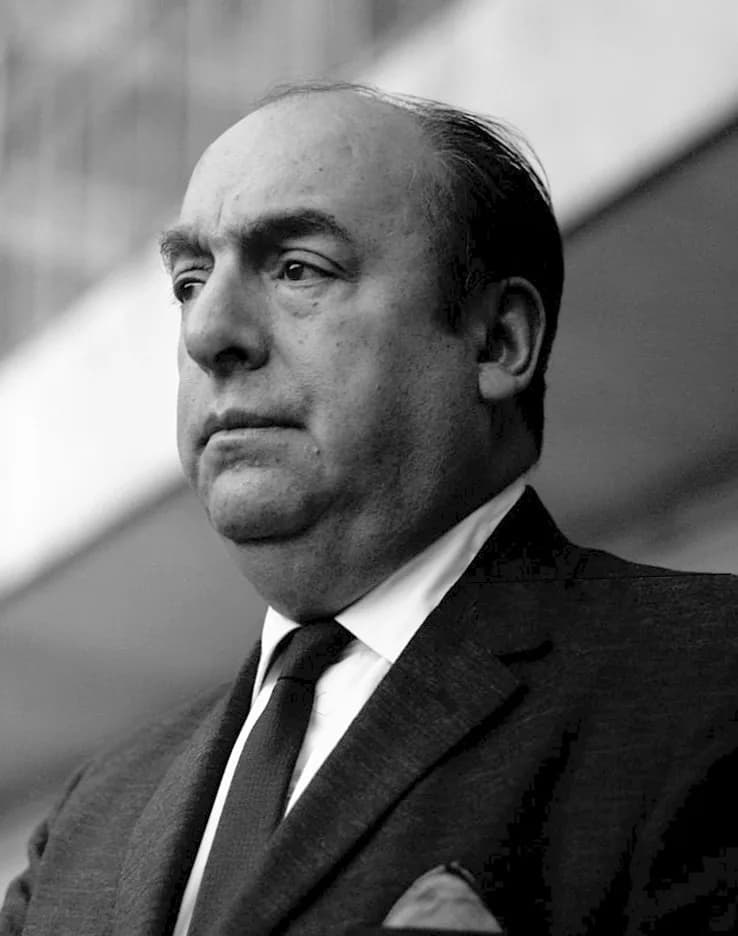
Pablo Neruda (1904–1973) was Chile best known for Chilean poet and politician.
Pablo Neruda (July 12, 1904 – September 23, 1973) was a Chilean poet-diplomat and politician. He won the 1971 Nobel Prize in Literature for his powerful poetry, which brought alive a continent's destiny and dreams. His diverse works continue to resonate globally.
Una vida en moments
Els moments que van marcar una vida
Capítol
Capítols de la vida
Capítol 1 · 1904· Capítol 1 de 6
Early Life and Origins
Ricardo Eliécer Neftalí Reyes Basoalto, later known universally as Pablo Neruda, first saw the light of day on July 12, 1904, in the picturesque town of Parral, nestled in the Maule Region of Chile. His father, José del Carmen Reyes Morales, worked diligently as a railway employee, a profession that often entailed significant travel and exposed the young Pablo to the diverse regions and vibrant cultures of Chile. This early immersion in travel and observation might have subtly influenced the poet's later expansive worldview and his desire to explore vast geographical and historical themes within his literary creations. His mother, Rosa Neftalí Basoalto Opazo, a dedicated schoolteacher, tragically passed away shortly after his birth, a profound and formative loss that undoubtedly cast a somber shadow over his early years and perhaps informed the contemplative and often melancholic spirit evident in much of his work.
Following this profound personal loss, the family made a significant relocation to Temuco, a bustling city situated in southern Chile, where Neruda spent much of his childhood and adolescence. This period in Temuco proved absolutely crucial for his intellectual and emotional development as a poet, as he was immersed in the vibrant natural world of the region and exposed to its rich cultural fabric. It was in this formative environment that his passion for literature began to take concrete and irreversible form, leading him to discreetly adopt the pen name Pablo Neruda, reportedly inspired by the revered Czech poet Jan Neruda, to avoid his father's strong disapproval of his burgeoning literary pursuits. His early surroundings and experiences deeply imprinted on his consciousness, providing an inexhaustible source of vivid imagery and potent inspiration for the lyrical, often emotionally charged tones that would characterize his later, celebrated works.
Capítol 2· Capítol 2 de 6
Career Beginnings
Pablo Neruda's extraordinary literary talent became strikingly evident at a remarkably young age, a true prodigy; he was already widely known as a poet when he was just 13 years old. This precocious early recognition was a powerful testament to his innate ability to craft compelling verse and articulate complex human emotions with a profound depth and eloquence that belied his years. His initial forays into poetry, even in his adolescence, demonstrated a nascent mastery of language, exploring universal themes of love, nature, and solitude that resonated deeply with readers and critics alike. These early experiments with poetic form and subject matter were foundational, establishing the groundwork for the exceptional stylistic versatility that would become a defining hallmark of his long and exceptionally distinguished career.
As he matured and honed his craft, Neruda continued to refine his unique artistic voice, writing in a wide array of styles that showcased his continuously evolving artistic vision and intellectual curiosity. His early works included intensely passionate love poems, which would later culminate in one of his most beloved and universally acclaimed collections, Twenty Love Poems and a Song of Despair, published when he was merely 20 years old. This remarkable collection solidified his burgeoning reputation as a master of evocative and emotionally charged verse. His stylistic versatility also extended profoundly to surrealist poems, where he bravely delved into abstract imagery and explored the subconscious realms of thought, pushing the established boundaries of traditional poetic expression and cementing his status as a daring and innovative voice in Chilean and Latin American literature.
Capítol 3 · 1971· Capítol 3 de 6
Major Achievements and Career Highlights
The unquestionable pinnacle of Pablo Neruda's illustrious literary career arrived in 1971 when he was deservedly awarded the Nobel Prize in Literature. The esteemed Swedish Academy bestowed this immense honor upon him with a citation specifically stating it was "for a poetry that with the action of an elemental force brings alive a continent's destiny and dreams," unequivocally acknowledging his profound and singular ability to capture the very spirit, history, and struggles of Latin America. This prestigious international award unequivocally solidified his standing as one of the most important global literary figures of the 20th century, bringing unparalleled international recognition to his extensive and diverse body of work and his truly unique poetic vision. The Nobel citation underscored the deep, inextricable connection between his poetic verse and the sweeping historical and intricate cultural narratives of his beloved homeland and its wider continent.
Beyond his undeniable literary genius, Neruda also meticulously carved out a significant and impactful career as a dedicated diplomat and an active, committed politician, serving his country, Chile, with unwavering dedication and profound conviction. His numerous roles as a poet-diplomat took him to various countries around the world, including esteemed postings in exotic Burma, culturally rich Argentina, historically complex Spain, and artistically vibrant France, where he consistently represented his nation with utmost distinction and cultural sensitivity. This extensive diplomatic experience undeniably broadened his perspective and significantly enriched his understanding of intricate global affairs, profoundly influencing the pronounced political and historical dimensions often found woven throughout his extensive poetry. As a politician, he actively engaged with the powerful social and ideological currents of his tumultuous era, consistently advocating for justice, equality, and human rights, effectively embodying the collective voice of the common people.
Capítol 4 · 1924· Capítol 4 de 6
Notable Works or Contributions
Pablo Neruda's comprehensive bibliography stands as a powerful testament to his prolific output, his extraordinary stylistic range, and his deeply varied poetic interests. One of his most enduring, widely read, and universally cherished collections, Twenty Love Poems and a Song of Despair, first published in 1924, immediately captivated readers across the globe with its raw, unflinching emotion and its exquisitely evocative imagery of love, passion, and longing. This collection, remarkably composed in his early youth, remains a foundational cornerstone of 20th-century love poetry, having been translated into countless languages and admired for its accessible yet profoundly deep exploration of human connection, desire, and heartbreak. Its universal themes of passion, vulnerability, and the bittersweet nature of affection continue to resonate powerfully with new generations of readers worldwide, firmly establishing him as an undisputed master of intimate and poignant verse.
Another monumental achievement in Neruda's expansive oeuvre is Canto general, a vast and ambitious historical epic first published in 1950. This sprawling work meticulously chronicles the intricate history, diverse geography, and complex political struggles of the entire American continent, spanning from its ancient pre-Columbian origins right through to the pressing contemporary challenges of the mid-20th century. Canto general masterfully incorporates elements of powerful political manifesto, detailed historical narrative, and soaring lyrical poetry, powerfully demonstrating Neruda's unparalleled ability to seamlessly blend intensely personal expression with grand, sweeping socio-political themes. The sheer scope, ambition, and intellectual depth of this work unequivocally solidified his reputation as a poet with a profound and unwavering commitment to his continent's past, present, and future, serving simultaneously as both a comprehensive historical account and an impassioned call to collective action.
His deep and unwavering engagement with significant political events is further vividly evident in works such as España en el corazón (Spain in My Heart), a poignant and powerful collection of poems born directly from his profound experiences and deeply personal observations during the devastating Spanish Civil War. This volume eloquently reflects his unwavering solidarity with the Republican cause and expresses profound sorrow, outrage, and empathy at the horrific conflict, showcasing his consistent and unwavering commitment to social justice and human dignity. Other politically charged works, often grouped under titles like Poesía política, further powerfully illustrate his significant role as a prominent public intellectual and an outspoken critic of oppression and injustice. He consistently harnessed his poetic voice as a potent and articulate instrument for profound political expression, translating complex social and ethical issues into accessible, deeply moving, and universally impactful verse.
Beyond these epic and often politically charged works, Neruda also produced more introspective and elemental collections, such as Sky stones, which elegantly explores profound themes of nature, geology, the sheer vastness of the cosmos, and humanity's place within it. His comprehensive prose autobiography, often considered a significant literary work in its own right, offered deeply personal insights into his fascinating life, his artistic inspirations, and his steadfast political convictions, providing readers with an invaluable and deeper understanding of the complex man behind the celebrated poetry. Collections like Selected poems offer a highly valuable entry point for new readers, providing a carefully curated and comprehensive overview of his extraordinary stylistic breadth, ranging from challenging surrealist pieces to straightforward lyrical compositions. His influence also extended profoundly into academic discourse, as evidenced by an Introduzione a Neruda, clearly indicating his undeniable significance as a prominent subject of critical study and literary analysis. Additionally, works like Altitud democrática de Chile [por el] presidente de la nación, escritores y pueblo and Tout l'amour further attest to his incredibly diverse interests and his continuous, passionate exploration of both national identity and universal human emotions.
Capítol 5 · 1971· Capítol 5 de 6
Later Years
The years immediately following Pablo Neruda's momentous reception of the Nobel Prize in Literature in 1971 brought both widespread international recognition and escalating political tensions within his beloved Chile. He returned to his homeland as a truly celebrated national hero, greeted with immense adoration, yet the political climate was becoming increasingly volatile and fraught with danger. His deep and enduring friendship and strong political allegiance with the democratically elected President Salvador Allende placed him squarely in the midst of the escalating ideological conflicts that gripped the nation. Neruda continued to write and passionately advocate for his deeply held beliefs, utilizing his global platform to voice his profound concerns and ardent hopes for Chile's uncertain future, demonstrating that his commitment to his country and its people was unwavering even in the face of profound national uncertainty and peril.
Tragically, Pablo Neruda passed away on September 23, 1973, in Santiago, Chile, a mere twelve days after the brutal military coup, led by General Augusto Pinochet, that violently overthrew President Allende's democratically elected government and ushered in a dark period of authoritarian dictatorship. His death, officially attributed to prostate cancer, occurred under circumstances that have since been a subject of intense scrutiny, widespread debate, and ongoing historical investigation, with many speculating about potential foul play given the extreme political unrest and the suddenness of his demise. This somber and politically charged timing further inextricably intertwined his personal legacy with the tumultuous and often tragic political history of Chile, ensuring that his final days would forever remain a poignant and contested symbol of a nation in profound and violent transition. His passing marked the undeniable end of a significant literary and political era for Chile, leaving a deep and resonant void that was felt across the globe.
Capítol 6· Capítol 6 de 6
Legacy and Impact
Pablo Neruda's legacy endures as a colossal and omnipresent force in world literature, with his poetry continuing to inspire, challenge, and provoke profound thought across countless generations and diverse cultures. The Nobel Committee's eloquent citation, recognizing his "poetry that with the action of an elemental force brings alive a continent's destiny and dreams," perfectly encapsulates his unique and powerful ability to articulate the profound aspirations, historical experiences, and inherent spirit of Latin America. He not only eloquently gave voice to the individual human heart through his intensely passionate love poems but also to the collective consciousness and historical memory of an entire continent through his vast historical epics and fervent, often revolutionary, political manifestos. His multifaceted body of work acts as a powerful bridge between the intensely personal and the universally resonant, making him profoundly accessible and deeply meaningful to a wide and incredibly varied audience around the world.
His immense influence is clearly evident in the countless poets, writers, activists, and intellectuals who have drawn profound inspiration from his extraordinary stylistic versatility and his unwavering, passionate commitment to social justice and human liberation. Neruda consistently demonstrated that poetry could be both intensely personal and deeply political, blurring the conventional lines between art and activism, proving that one could inform the other. From the intellectually stimulating surrealist poems that courageously challenged conventional perceptions and artistic norms to the accessible prose of his revealing autobiography, he engaged with life in all its inherent complexity and contradiction. Pablo Neruda remains an absolutely essential figure whose profound and beautiful language continues to shape literary traditions globally and foster a deeper, more empathetic appreciation for the intrinsic power of words to reflect, interpret, and ultimately influence the intricate tapestry of the human condition.
FAQ
Preguntes freqüents
Quan va morir Pablo Neruda?
Pablo Neruda va morir el 23 de setembre del 1973 a Santiago, Chile, als 69 anys.
On va néixer Pablo Neruda?
Pablo Neruda va néixer a Parral, Chile el 12 de juliol del 1904.
Per què és més conegut/da Pablo Neruda?
Pablo Neruda és conegut/da sobretot per Chilean poet and politician.
Quants anys tenia Pablo Neruda quan va morir?
Pablo Neruda tenia 69 anys en el moment de la seva mort.
Quina nacionalitat tenia Pablo Neruda?
Pablo Neruda era de Chile.
Cronologia
La vida en un cop d'ull
Galeria de fotos
Una vida en imatges
Feu clic a qualsevol polaroid per ampliar · 48 fotos
Codi QR
Comparteix aquesta biografia
Imprimeix i comparteix
Escaneja per visitar aquesta pàgina de biografia. Imprimeix per a esdeveniments, exposicions o materials educatius.