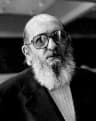
Doğulub
September 19, 1926
Toyohashi, Japan
Vəfat edib
November 12, 2020
Tokyo, Japan
Tanındığı sahə
Japanese physicist and astronomer
Masatoshi Koshiba (1926-2020) was a Japanese physicist and astronomer who founded the field of neutrino astronomy. His work with the Kamiokande detector provided the first experimental detection of solar neutrinos, earning him the 2002 Nobel Prize in Physics.
Fəsil
Həyat fəsilləri
Fəsil 1 · 1926· Fəsil 1 / 6
Early Life and Origins
Born on September 19, 1926, in Toyohashi, Japan, Koshiba entered the world during a time of rapid technological advancement. His hometown in Aichi Prefecture would serve as the launching point for a career that would span continents and decades. Growing up in Japan during the early 20th century, he witnessed his country's dramatic transformation and modernization. The young Koshiba showed an early aptitude for mathematics and science, qualities that would define his future contributions to physics.
Fəsil 2· Fəsil 2 / 6
Career Beginnings
Koshiba's entry into the world of physics came through traditional academic channels, but his ambitions quickly expanded beyond conventional boundaries. He recognized early in his career that the most exciting discoveries lay at the intersection of theoretical physics and experimental innovation. His initial work focused on particle physics, but he became increasingly fascinated by the potential to study cosmic phenomena through particle detection. This interest would prove to be the foundation for his most significant contributions to science.
Fəsil 3· Fəsil 3 / 6
Major Achievements and Career Highlights
Koshiba's greatest achievement came through his work with neutrino detection systems, particularly the Kamiokande and Super-Kamiokande detectors. These massive underground facilities, built in Japanese mines, were designed to catch the nearly massless particles that stream constantly through Earth from the sun and other cosmic sources. His team's success in detecting solar neutrinos provided the first experimental evidence for what scientists called the solar neutrino problem—a discrepancy between theoretical predictions and observed neutrino counts.
In 2002, Koshiba received the Nobel Prize in Physics for his pioneering contributions to astrophysics, specifically for the detection of cosmic neutrinos. This recognition came as validation for decades of painstaking work developing detection methods for particles so elusive they can pass through entire planets without interaction. His achievement essentially created the field of neutrino astronomy, giving scientists a new tool to study stellar processes and cosmic events.
Fəsil 4· Fəsil 4 / 6
Notable Works and Contributions
Throughout his career, Koshiba authored 274 academic papers with an h-index of 62, demonstrating both the volume and impact of his research. His influence continued well beyond his active research years, with important studies continuing to emerge from the Super-Kamiokande project. Recent notable publications include work on the Diffuse Supernova Neutrino Background Search, studies of proton decay, and investigations into supernova neutrino bursts.
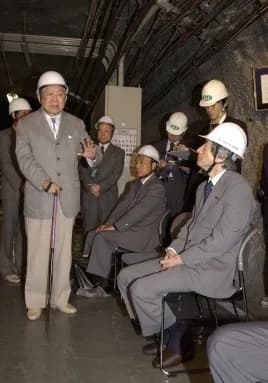
The Kamiokande detector, which Koshiba helped develop and operate, became one of the most important scientific instruments of the late 20th century. Located 1,000 meters underground in the Kamioka mine, it consisted of a tank filled with 3,000 tons of ultra-pure water surrounded by sensitive light detectors. When neutrinos occasionally interacted with water molecules, they produced flashes of light that the detectors could capture. This ingenious design made visible the previously invisible world of neutrino interactions.
Fəsil 5· Fəsil 5 / 6
Later Years
Even after receiving the Nobel Prize, Koshiba remained active in the scientific community and continued to support the advancement of neutrino research. His later years saw him take on roles as an elder statesman of physics, mentoring younger researchers and advocating for continued investment in fundamental research. The Super-Kamiokande facility continued to produce important results, building on the foundation he had established. His influence extended beyond his direct research contributions to shaping the next generation of particle physicists and astronomers.
Fəsil 6 · 2020· Fəsil 6 / 6
Legacy and Impact
Koshiba's death on November 12, 2020, in Tokyo marked the end of an era in particle physics, but his scientific legacy continues through ongoing research at the facilities he helped create. The detection techniques he pioneered have become standard tools in modern astrophysics, enabling scientists to study everything from solar fusion processes to distant supernovae. His work demonstrated that particles invisible to conventional telescopes could serve as messengers from the most extreme environments in the universe.
The field of neutrino astronomy, which barely existed before Koshiba's work, now represents one of the most active areas of astrophysical research. Modern neutrino observatories around the world, from Antarctica to the Mediterranean Sea, use principles and techniques that trace back to his original innovations. His contribution extends beyond any single discovery to encompass an entirely new way of observing and understanding the cosmos, ensuring his influence on science will continue for generations to come.
Anlarda bir həyat
Bir həyatı formalaşdıran anlar



FAQ
Tez-tez verilən
Masatoshi Koshiba nə vaxt vəfat edib?
Masatoshi Koshiba 12 noyabr 2020 tarixində Tokyo, Japan-də, 94 yaşında vəfat edib.
Masatoshi Koshiba harada anadan olub?
Masatoshi Koshiba Toyohashi, Japan-də 19 sentyabr 1926 tarixində anadan olub.
Masatoshi Koshiba ən çox nə ilə tanınır?
Masatoshi Koshiba ən çox Japanese physicist and astronomer ilə tanınır.
Masatoshi Koshiba öldüyü zaman neçə yaşında idi?
Masatoshi Koshiba öldüyü zaman 94 yaşında idi.
Masatoshi Koshiba-in milliyyəti nə idi?
Masatoshi Koshiba Japan-dan idi.
Xronologiya
Bir baxışda həyat
Foto qalereyası
Şəkillərdə bir həyat
Genişləndirmək üçün polaroidə klikləyin · 11 foto
QR kod
Bu bioqrafiyanı paylaş
Çap et və paylaş
Bu bioqrafiya səhifəsini ziyarət etmək üçün skan edin. Tədbirlər, sərgilər və ya təhsil materialları üçün çap edin.