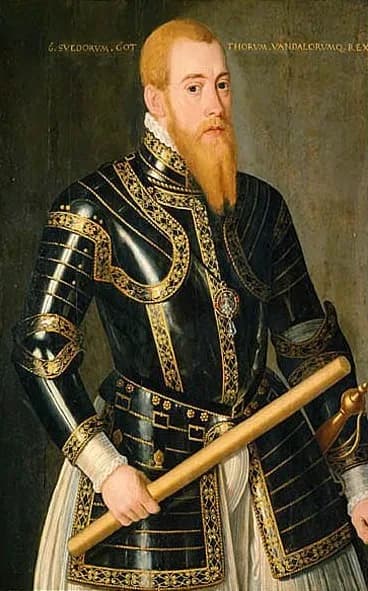
Doğulub
December 13, 1533
Tre Kronor Castle, Sweden
Vəfat edib
February 26, 1577
Örbyhus, Sweden
Tanındığı sahə
Swedish king
Eric XIV of Sweden (1533–1577) was Sweden best known for Swedish king.
Eric XIV of Sweden (December 13, 1533 – February 26, 1577) was a monarch from Sweden. He ascended the throne after his father's death and expanded Swedish influence by ruling Estonia. His reign ended with a rebellion led by his half-brother, leading to his incarceration and deposition.
Fəsil
Həyat fəsilləri
Fəsil 1 · 1533· Fəsil 1 / 6
Early Life and Lineage
Eric XIV first entered the world on December 13, 1533, at the historic Tre Kronor Castle in Sweden. This grand royal fortress served as the epicenter of Swedish power and tradition for centuries. His birth within these venerable walls inherently linked him to the very heart of the Swedish monarchy and the Vasa dynasty.
As the eldest son of Gustav I, the revered founder of modern Sweden, Eric XIV was destined for kingship from the moment of his birth. His upbringing was meticulously tailored to prepare him for the immense responsibilities of the crown. He was immersed in an environment focused on statecraft, noble deportment, and the complex duties awaiting a future monarch.
Growing up, Eric XIV observed his father's strategic leadership and the consolidation of Swedish independence. This formative period undoubtedly shaped his understanding of power, governance, and the challenges of ruling a kingdom in the tumultuous 16th century. His lineage provided him with a direct claim to a powerful and evolving nation.
Fəsil 2 · 1560· Fəsil 2 / 6
Accession to the Throne
The path to the throne for Eric XIV was formally opened upon the death of his father, Gustav I, on September 29, 1560. This pivotal event marked the end of one reign and the beginning of another, as Eric XIV immediately ascended to the position of King of Sweden. The transfer of power was a momentous occasion, solidifying his role as the supreme ruler.
Assuming the kingship meant stepping into a role previously defined by a formidable and charismatic father. Eric XIV faced the immediate challenge of asserting his own authority and demonstrating his capabilities as a sovereign. His early actions as monarch were closely watched, setting the tone for his tenure at the head of the Swedish state.
Fəsil 3 · 1561· Fəsil 3 / 6
Reign and Expansion
A significant highlight of Eric XIV's reign was the strategic expansion of Swedish influence into Estonia. In 1561, Estonia actively sought and placed itself under Swedish protection, a move that formally designated Eric XIV as its ruler. This diplomatic success considerably broadened the geographical reach and political weight of the Swedish kingdom across the Baltic Sea.
The addition of Estonia to the Swedish dominion represented a key achievement in foreign policy under Eric XIV. It established a vital Swedish presence in a region of significant geopolitical importance, enhancing control over trade routes and influencing regional power dynamics. This expansion demonstrated his strategic vision for Sweden's role in Northern Europe.
Beyond this expansion, Eric XIV's time on the throne involved navigating various international relations and domestic affairs. As monarch, he was responsible for the welfare of his subjects, the administration of justice, and the defense of the realm. His decisions during this period had lasting consequences for the development of Sweden.
Fəsil 4 · 1568· Fəsil 4 / 6
Political Conflicts and Imprisonment
Despite early successes, Eric XIV's reign became increasingly fraught with internal political conflicts. These tensions escalated into a major rebellion against his authority in 1568. This uprising was orchestrated by his half-brother, John III, highlighting deep-seated rivalries and power struggles within the royal family itself.
The rebellion proved to be a decisive and ultimately devastating turning point for Eric XIV. Following its success, he was formally incarcerated by John III. This act marked a dramatic and precipitous fall from power, transforming him from an reigning monarch into a royal prisoner, stripped of his crown and freedom.
His formal deposition by the Riksdag on January 26, 1569, legally affirmed the change in leadership. This parliamentary decree officially removed him from the throne, thereby ratifying the transfer of power to his half-brother. The Riksdag's decision concluded his contentious time as the active King of Sweden.
Fəsil 5· Fəsil 5 / 6
Final Years and Demise
After his deposition, Eric XIV spent the remainder of his life in various prisons across Sweden. His imprisonment was a period of isolation and confinement, far removed from the royal courts and political intrigues he once commanded. The exact conditions of his captivity varied, but his freedom was definitively curtailed.
His long incarceration culminated in his death on February 26, 1577, at Örbyhus in Sweden. This historic location became the final resting place of a monarch whose life had encompassed both the heights of royal power and the depths of political misfortune. His passing closed a tumultuous and often tragic chapter of a Swedish king's life.
Fəsil 6· Fəsil 6 / 6
Enduring Legacy
Eric XIV's reign, though ultimately ending in deposition and imprisonment, holds a distinct and compelling place within Swedish history. His leadership saw the significant expansion of Swedish territorial claims with the acquisition of Estonia, an achievement that shaped Sweden's future imperial ambitions. This contribution undeniably left a mark on the nation's geopolitical landscape.
The narrative of his internal struggles, particularly the rebellion led by his half-brother, provides invaluable insight into the often brutal dynamics of power within royal families during the early modern period. His life serves as a potent illustration of the personal and political risks inherent in holding a monarchical position. Historians often revisit his story to understand the challenges of royal succession and authority.
Ultimately, Eric XIV's legacy is woven into the broader historical narrative of the Vasa dynasty's efforts to establish Sweden as a dominant force in Northern Europe. His era, characterized by both strategic expansion and profound internal conflict, contributes significantly to the understanding of 16th-century Swedish state-building. His impact, though complex, is an essential part of the historical record.
Anlarda bir həyat
Bir həyatı formalaşdıran anlar


FAQ
Tez-tez verilən
Eric XIV of Sweden nə vaxt vəfat edib?
Eric XIV of Sweden 26 fevral 1577 tarixində Örbyhus, Sweden-də, 43 yaşında vəfat edib.
Eric XIV of Sweden harada anadan olub?
Eric XIV of Sweden Tre Kronor Castle, Sweden-də 13 dekabr 1533 tarixində anadan olub.
Eric XIV of Sweden ən çox nə ilə tanınır?
Eric XIV of Sweden ən çox Swedish king ilə tanınır.
Eric XIV of Sweden öldüyü zaman neçə yaşında idi?
Eric XIV of Sweden öldüyü zaman 43 yaşında idi.
Eric XIV of Sweden-in milliyyəti nə idi?
Eric XIV of Sweden Sweden-dan idi.
Xronologiya
Bir baxışda həyat
Foto qalereyası
Şəkillərdə bir həyat
Genişləndirmək üçün polaroidə klikləyin · 24 foto
QR kod
Bu bioqrafiyanı paylaş
Çap et və paylaş
Bu bioqrafiya səhifəsini ziyarət etmək üçün skan edin. Tədbirlər, sərgilər və ya təhsil materialları üçün çap edin.